700R4 Information Thread

Disclaimer: Links on this page pointing to Amazon, eBay and other sites may include affiliate code. If you click them and make a purchase, we may earn a small commission.

Ricko1966

Full Access Member
Joined
Apr 11, 2017
Posts
10,013
Reaction score
19,243
Location
kansas
First Name
Rick
Truck Year
1975
Truck Model
c20
Engine Size
350
@nick Transmission, Strange question ,I know. But is there any reason I can't use a 4l60e as a donor to rebuild an 85 700r4 use all the 4l60 internals ,minus pump,use the 85 valve body. I'd think that would give me a decent transmission. And 4l60E cores are lots easier to come by than 88-92 700s
 
Last edited:

NickTransmissions

Full Access Member
Joined
Aug 3, 2023
Posts
649
Reaction score
1,295
Location
Las Vegas
First Name
Nick
Truck Year
1987
Truck Model
R10
Engine Size
350
@nick Transmission, Strange question ,I know. But is there any reason I can't use a 4l60e as a donor to rebuild an 85 700r4 use all the 4l60 internals ,minus pump,use the 85 valve body. I'd think that would give me a decent transmission. And 4l60E cores are lots easier to come by than 88-92 700s
You can but your 1985 unit was designed to use a drum with a 2mm forward feed orifice in the forward drum. The 87+ 700s and 4L60Es all have drums with 6mm orifices as they were designed to work with a forward accumulator circuit. So your engagement into drive would be particularly harsh, especially when the vehicle is cold (i.e. sitting overnight). The reverse drum from the 60E is backwards compatible but likely not usable as nearly 100% of them are warped on the band surface so you're buying a new one anyway.

The pump can be installed however a couple mods have to be done to make it work in the early non-aux VB 700r4 (it's easier to retro the 4L60E pump into an earlier 700r4 than a late given the aux VB feed pipe to the forward clutch circuit has to be accounted for and circuitry re-routed). All other case components gears, shell, etc are interchangeable - just keep your 700's input shaft since the 60E shaft has no worm gear for the governor.
 

TDoc

Full Access Member
Joined
Jun 8, 2021
Posts
176
Reaction score
270
Location
Flagstaff, Arizona
First Name
Terrell
Truck Year
1979, 1986
Truck Model
K10, K5
Engine Size
400, 305
86 K5 700R4 3:73 gears. Did a driveway complete trans flush 2k miles ago with maxlife dex full synthetic. Shifts great! Fluid was very dark when I got the blazer. Put 2k miles on it and dropped pan. Looks great! Magnets had a decent amount of black goo but hardly anything in bottom of pan. The two little rings of clutch material in the corner are from a magnet I have outside the pan.
You must be registered for see images attach

@NickTransmissions
I also got the torque converter to lock. Who knows how many years and miles it’s been not locking. Now it locks in 2,3,4th. Like immediately when vacuum levels are high. Almost to the point it’s annoying. Is that ok or am I going to cause premature wear? I hooked it to manifold vacuum.

I’m sure this trans has been rebuilt or replaced. It has the gmt400 red dip stick, not sure how to tell what year the 700r4 is, I thought the pan was leaking but it’s two of the pump bolts. I tried to stop or slow it. You can’t get the bolts out without removing or moving the transmission back.
xc_hide_links_from_guests_guests_error_hide_media

 
Last edited:

HotRodPC

Administrator
Staff member
Moderator Administrator
Joined
Aug 29, 2010
Posts
47,836
Reaction score
10,979
Location
OKC, OK
First Name
HotRod
Truck Year
85 K20 LWB
Truck Model
Silverado
Engine Size
454 - Turbo 400 - 3.73
86 K5 700R4 3:73 gears. Did a driveway complete trans flush 2k miles ago with maxlife dex full synthetic. Shifts great! Fluid was very dark when I got the blazer. Put 2k miles on it and dropped pan. Looks great! Magnets had a decent amount of black goo but hardly anything in bottom of pan. The two little rings of clutch material in the corner are from a magnet I have outside the pan.
You must be registered for see images attach

@NickTransmissions
I also got the torque converter to lock. Who knows how many years and miles it’s been not locking. Now it locks in 2,3,4th. Like immediately when vacuum levels are high. Almost to the point it’s annoying. Is that ok or am I going to cause premature wear? I hooked it to manifold vacuum.

I’m sure this trans has been rebuilt or replaced. It has the gmt400 red dip stick, not sure how to tell what year the 700r4 is, I thought the pan was leaking but it’s two of the pump bolts. I tried to stop or slow it. You can’t get the bolts out without removing or moving the transmission back.
xc_hide_links_from_guests_guests_error_hide_media

Nick can respond too, but not sure when he'll get here. I'd say, you're not getting lock up in 2nd I wouldn't think. Pressure switches should only allow that in 3rd and 4th sometimes just 4th. But I've never heard of a lock up in 2nd. But hey, maybe your set up and hook up doesn't require or depend on pressure switches and I guess that's possible, all in how you hooked it up and wired it. Obviously it's electronic. I'd have to say NO, you will NOT get them bolts out, even if they are exposed. They're to long and not going to clear without hitting the torque converter would be my thought. BUT, is it possible the bolts are loose? Can you get a wrench in there to reach them and get an idea of the torque on them? Don't overtighten whatever you do, you can easily stip those threads if that's not the problem already. Whoever built it, might have forgotten or didn't use the bolt washer gaskets, or under tightened or over tightened and stripped out the alluminum, which is easly fixed with helicoils but then you have to have the whole transmission out, and do it in a way you don't get shavings in the transmission. That won't be good either. But see if you can get a wrench in there and see if maybe a little snug if they are loose will correct the leak. Then you at least know what it's going to take to fix it.

BTW, don't change it now, but for that transmission, I probably wouldn't have used synthetic fluid. If it's been freshely rebuilt and in good shape, you have a good chance of it being OK, but if it was well worn, it's not going to last any longer in fact likley less. good fluid high in detergents, thinner will tend to get around worn seals and parts where as standard fluid may have been better. Once a transmission is badly worn if it hasn't been maintained, don't think a fluid change will fix it. That'll probably kill it at that point and that's usually when people decide to maintain it, is when it's ailing and they think a fluid and filter change will help when it when in fact, total opposite. Clean all that gunk built up in the drums out of it, now your tolerances just increased by all the space you just created getting all the built up gunk out of it. New Clean Trans fluid is a great detergent. It does clean things and sometimes, the damage has been done, you don't want it cleaned out. That does NOT seem to be in your case, so YOU are probably good thankfully, but keep it in mind in the future or on other transmissions.
 
Last edited:

TDoc

Full Access Member
Joined
Jun 8, 2021
Posts
176
Reaction score
270
Location
Flagstaff, Arizona
First Name
Terrell
Truck Year
1979, 1986
Truck Model
K10, K5
Engine Size
400, 305
I checked those bolts and they are tight. I loosened the two in the video, and put some sealer around the washers as it looked like they were leaking. They tightened up just fine. I’ll have to drop the inspection cover again and see if it’s still leaking. If so, I’ll try some ultra grey RTV as you can’t get the bolts out completely.

Trans shifted fine when I got it just dirty but not burnt. I also added an external trans cooler and hottest it’s gotten is 160F offroad and long highway trips.

I swear it locks in 2nd as well. The revs will drop and you can feel it lock.

Thanks for the detailed response!
 

NickTransmissions

Full Access Member
Joined
Aug 3, 2023
Posts
649
Reaction score
1,295
Location
Las Vegas
First Name
Nick
Truck Year
1987
Truck Model
R10
Engine Size
350
86 K5 700R4 3:73 gears. Did a driveway complete trans flush 2k miles ago with maxlife dex full synthetic. Shifts great! Fluid was very dark when I got the blazer. Put 2k miles on it and dropped pan. Looks great! Magnets had a decent amount of black goo but hardly anything in bottom of pan. The two little rings of clutch material in the corner are from a magnet I have outside the pan.
You must be registered for see images attach

@NickTransmissions
I also got the torque converter to lock. Who knows how many years and miles it’s been not locking. Now it locks in 2,3,4th. Like immediately when vacuum levels are high. Almost to the point it’s annoying. Is that ok or am I going to cause premature wear? I hooked it to manifold vacuum.

I’m sure this trans has been rebuilt or replaced. It has the gmt400 red dip stick, not sure how to tell what year the 700r4 is, I thought the pan was leaking but it’s two of the pump bolts. I tried to stop or slow it. You can’t get the bolts out without removing or moving the transmission back.
xc_hide_links_from_guests_guests_error_hide_media
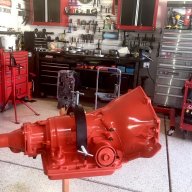
The 82-86 valve bodies had three pressure switches to support a TCC strategy that locks the converter starting in 2nd gear to increase fuel economy. I believe some of the Corvettes and Fbodies had this feature, but don't quote me on that.

Not sure what you mean by hooking up to manifold vacuum but the 700r4s TCC use the three-pin case connector and an external wiring harness to bring power/C3 from the ECU/ECM to the transmission so the converter clutch lock up solenoid can be controlled.

Alternatively, some factory TCC set ups used the TCC shift/throttle valve train in the valve body itself to control the converter clutch, with no electro-mechanical input. These were also prevalent in 82-86. 1987 VBs only had two pressure switches while 88+ received only one pressure switch, though I think the lock up strategy is the same as 1987.

Look on the passenger side of the transmission, just above the pan at the very rear of the case and you'll see an alpha-numeric code stamped into the case. The first character is an integer - that corresponds to the year of production. If you see a '2' or a '3' and the unit is a non-auxiliary valve body unit, then you have a 1982 / 1983 transmission. If you have an aux-VB, then it would be a 1992 or 1993 unit.
 

TDoc

Full Access Member
Joined
Jun 8, 2021
Posts
176
Reaction score
270
Location
Flagstaff, Arizona
First Name
Terrell
Truck Year
1979, 1986
Truck Model
K10, K5
Engine Size
400, 305
The 82-86 valve bodies had three pressure switches to support a TCC strategy that locks the converter starting in 2nd gear to increase fuel economy. I believe some of the Corvettes and Fbodies had this feature, but don't quote me on that.

Not sure what you mean by hooking up to manifold vacuum but the 700r4s TCC use the three-pin case connector and an external wiring harness to bring power/C3 from the ECU/ECM to the transmission so the converter clutch lock up solenoid can be controlled.

Alternatively, some factory TCC set ups used the TCC shift/throttle valve train in the valve body itself to control the converter clutch, with no electro-mechanical input. These were also prevalent in 82-86. 1987 VBs only had two pressure switches while 88+ received only one pressure switch, though I think the lock up strategy is the same as 1987.

Look on the passenger side of the transmission, just above the pan at the very rear of the case and you'll see an alpha-numeric code stamped into the case. The first character is an integer - that corresponds to the year of production. If you see a '2' or a '3' and the unit is a non-auxiliary valve body unit, then you have a 1982 / 1983 transmission. If you have an aux-VB, then it would be a 1992 or 1993 unit.

I hooked up these vacuum switches to manifold vacuum. I believe one or both control the lockup. They were disconnected when I bought the k5.
You must be registered for see images attach
 

HotRodPC

Administrator
Staff member
Moderator Administrator
Joined
Aug 29, 2010
Posts
47,836
Reaction score
10,979
Location
OKC, OK
First Name
HotRod
Truck Year
85 K20 LWB
Truck Model
Silverado
Engine Size
454 - Turbo 400 - 3.73
I hooked up these vacuum switches to manifold vacuum. I believe one or both control the lockup. They were disconnected when I bought the k5.
You must be registered for see images attach
The one behind the dipstick tube on the firewall is the tip in switch for the ESC, so that tells me this was an OE 305 truck. The one behind the master cylinder is your TCC lock up vac switch.
 

TDoc

Full Access Member
Joined
Jun 8, 2021
Posts
176
Reaction score
270
Location
Flagstaff, Arizona
First Name
Terrell
Truck Year
1979, 1986
Truck Model
K10, K5
Engine Size
400, 305
The one behind the dipstick tube on the firewall is the tip in switch for the ESC, so that tells me this was an OE 305 truck. The one behind the master cylinder is your TCC lock up vac switch.
Still got the original 305 with 200k. Smokes but still decent power considering its only a 305.
xc_hide_links_from_guests_guests_error_hide_media

 

HotRodPC

Administrator
Staff member
Moderator Administrator
Joined
Aug 29, 2010
Posts
47,836
Reaction score
10,979
Location
OKC, OK
First Name
HotRod
Truck Year
85 K20 LWB
Truck Model
Silverado
Engine Size
454 - Turbo 400 - 3.73
The 82-86 valve bodies had three pressure switches to support a TCC strategy that locks the converter starting in 2nd gear to increase fuel economy. I believe some of the Corvettes and Fbodies had this feature, but don't quote me on that.

Not sure what you mean by hooking up to manifold vacuum but the 700r4s TCC use the three-pin case connector and an external wiring harness to bring power/C3 from the ECU/ECM to the transmission so the converter clutch lock up solenoid can be controlled.

Alternatively, some factory TCC set ups used the TCC shift/throttle valve train in the valve body itself to control the converter clutch, with no electro-mechanical input. These were also prevalent in 82-86. 1987 VBs only had two pressure switches while 88+ received only one pressure switch, though I think the lock up strategy is the same as 1987.

Look on the passenger side of the transmission, just above the pan at the very rear of the case and you'll see an alpha-numeric code stamped into the case. The first character is an integer - that corresponds to the year of production. If you see a '2' or a '3' and the unit is a non-auxiliary valve body unit, then you have a 1982 / 1983 transmission. If you have an aux-VB, then it would be a 1992 or 1993 unit.
See, I learned something. I had never heard of there being a Vac switch for 2nd gear lock up. That's almost ridiculous really. As he said, that would get annoying. So maybe you can tell him which one would be the 2nd gear pressure switch and next time he has the pan off, I'd be pulling a wire off that dude for just a 3 and 4 TCC lock up options. yeah, I'd have never expected there to be a 2nd gear lock up.
 

HotRodPC

Administrator
Staff member
Moderator Administrator
Joined
Aug 29, 2010
Posts
47,836
Reaction score
10,979
Location
OKC, OK
First Name
HotRod
Truck Year
85 K20 LWB
Truck Model
Silverado
Engine Size
454 - Turbo 400 - 3.73
Still got the original 305 with 200k. Smokes but still decent power considering its only a 305.
Well when it dies you'll be getting a Tree Fitty. Rebuild kits and even crate engines are cheaper in 350 than Wee O Fives. Even the aftermarket world is tryna make the Wee O Fives extinct.

For a minute I thought you might be losing your mind, there's no lock up in 2nd you're imagining things LOL Well, Nick just learned me that through 86 there is pressure switches for 2nd. I'd be disconnecting that one next time you get in the pan. Just be sure you get the right one. It would suck to have disconnected 4th and then have 2nd and 3rd lock up but no 4th. Some people would be anal and want to remove the switch and plug it, but it'll be fine just to leave the switch as a plug so long as the wire is disconnected, then it won't be able to send signal for lock up and you're good to go.
 

TDoc

Full Access Member
Joined
Jun 8, 2021
Posts
176
Reaction score
270
Location
Flagstaff, Arizona
First Name
Terrell
Truck Year
1979, 1986
Truck Model
K10, K5
Engine Size
400, 305
Well when it dies you'll be getting a Tree Fitty. Rebuild kits and even crate engines are cheaper in 350 than Wee O Fives. Even the aftermarket world is tryna make the Wee O Fives extinct.

For a minute I thought you might be losing your mind, there's no lock up in 2nd you're imagining things LOL Well, Nick just learned me that through 86 there is pressure switches for 2nd. I'd be disconnecting that one next time you get in the pan. Just be sure you get the right one. It would suck to have disconnected 4th and then have 2nd and 3rd lock up but no 4th. Some people would be anal and want to remove the switch and plug it, but it'll be fine just to leave the switch as a plug so long as the wire is disconnected, then it won't be able to send signal for lock up and you're good to go.
Compared to the 350 of the same year the 305 was only 5hp less. Down on torque but at least it had a high compression ratio for the time. The dual exhaust and tall air cleaner maybe freed up a few hp. I’m just happy it runs decent.
You must be registered for see images attach

I’d like to put a 96-98 L31 vortec 350 in it someday or maybe LS 5.3.
 
Last edited:

HotRodPC

Administrator
Staff member
Moderator Administrator
Joined
Aug 29, 2010
Posts
47,836
Reaction score
10,979
Location
OKC, OK
First Name
HotRod
Truck Year
85 K20 LWB
Truck Model
Silverado
Engine Size
454 - Turbo 400 - 3.73
Compared to the 350 of the same year the 305 was only 5hp less. Down on torque but at least it had a high compression ratio for the time. The dual exhaust and tall air cleaner maybe freed up a few hp. I’m just happy it runs decent.
You must be registered for see images attach


I’d like to put a 96-98 L31 vortec 350 in it someday or maybe LS 5.3.
yes, But Torque is huge. See, we are trained to talk horsepower when horsepower doesn't matter near as much as torque. For what the 305 was and it's purposes it was certainly good in it's time and it pleased the Feds and that was the main intent of the 305, was to meet the EPA's FLEET requirement on Emissions and MPG. By that I mean, when the Gubment steps in and say we want these emissions and this much mpg in all the vehicles you sell, they're talking all the vehicles or fleet of vehicles they sell. So if they can get most of them to meet or beat that criteria, then some other models don't have to because the Fleet AVERAGE met the criteria. So they sold a whole bunch of LE9 trucks with ESC and made it standard equipment. This is also why we ended with trucks having overdirve and 2.73 or 3.08 gear ratios especailly when the speed limit was 55mph nationwide. Totally ridiculous, but they had to please the Feds and the computer technology wasn't there yet. Now we beat that criteria to all hell, and it's even tighter now and speed limits are 80 in some places and we have vehicles with 300hp as the norm and even in the 500's for the sport vehicles like Hell Cats, Vettes, Cad CTSV's etc. As Richard Petty said, HORSEPOWER sells cars, yes it does cuz that's the language we've been taught to speak, But TORQUE wins races. Richard Petty's famous quote in the winner's circle post interview I do beleive.
 

bucket

Super Moderator
Staff member
Moderator
Joined
Aug 3, 2010
Posts
35,228
Reaction score
44,013
Location
Usually not in Ohio
First Name
Andy
Truck Year
'77, '78, '79, '84, '88
Truck Model
K5 thru K30
Engine Size
350-454
The 82-86 valve bodies had three pressure switches to support a TCC strategy that locks the converter starting in 2nd gear to increase fuel economy. I believe some of the Corvettes and Fbodies had this feature, but don't quote me on that.

Not sure what you mean by hooking up to manifold vacuum but the 700r4s TCC use the three-pin case connector and an external wiring harness to bring power/C3 from the ECU/ECM to the transmission so the converter clutch lock up solenoid can be controlled.

Alternatively, some factory TCC set ups used the TCC shift/throttle valve train in the valve body itself to control the converter clutch, with no electro-mechanical input. These were also prevalent in 82-86. 1987 VBs only had two pressure switches while 88+ received only one pressure switch, though I think the lock up strategy is the same as 1987.

Look on the passenger side of the transmission, just above the pan at the very rear of the case and you'll see an alpha-numeric code stamped into the case. The first character is an integer - that corresponds to the year of production. If you see a '2' or a '3' and the unit is a non-auxiliary valve body unit, then you have a 1982 / 1983 transmission. If you have an aux-VB, then it would be a 1992 or 1993 unit.

You are correct, the F-bodies through '86 also featured a 2nd gear lockup. And @HotRodPC you are correct too, it can be very annoying. I just researched this recently as the insanely low lockup speeds on my '86 Camaro were really getting to me. I did not remember my other 86's being that way. Upon research, there were customer complaints back then about driveability issues due to the low lockup speeds and there were revised ECM chips installed at the dealer that delayed lockup to around 40 mph (rather than the 14mph it had been). I installed one of the later chips and no more stupid low lockup speeds. Now, this of course was a fuel injected car. I'd imagine that the carbed cars with vacuum switches may do a better job and not be as bothersome.
 

Forum statistics

Threads
48,470
Posts
1,068,592
Members
42,907
Latest member
x75x75x75
Top