
Let’s talk PCV systems.

Disclaimer: Links on this page pointing to Amazon, eBay and other sites may include affiliate code. If you click them and make a purchase, we may earn a small commission.

ChuckN

Full Access Member
Joined
Nov 8, 2022
Posts
2,082
Reaction score
7,636
Location
Bellinham, WA
First Name
Chad
Truck Year
1981
Truck Model
C10
Engine Size
350
On my old engine, I always ran two breathers. Partly because of the minor hassle of setting it up and finding a reputable PCV valve, but mostly because I was having carb tuning issues and didn’t want to introduce another variable.

So, since I’m starting over from scratch, I wanted to ask some questions.

1. How much will it affect carb tuning, assuming I can get a good seal at the VC and a good valve?

2. How much will the crud being sucked in affect engine performance?

3. Will it eventually “coke up” the inside of the intake manifold?

4. How many people have found a creative way to hide or mount a catch can? I’ve yet to delete the old AC box on the passenger side, and elsewhere there isn’t a lot of space on the firewall, and someday I may want to mount a fuel regulator there too.

Looking at the old engine when I took off the intake, I did see some white residue. It could have been old assembly lube, but I’m wondering if it had a slight water leak or maybe a condensation problem.

Enquiring minds want to know. Thanks in advance about your thoughts and suggestions.

Chad
 

Ricko1966

Full Access Member
Joined
Apr 11, 2017
Posts
9,940
Reaction score
19,069
Location
kansas
First Name
Rick
Truck Year
1975
Truck Model
c20
Engine Size
350
The PCV does way more good than harm. It helps with ring seal, keeps water vapors out of the crankcase,creates a vacuum in the crankcase to minimize weeping seals and gaskets. It's just vapor your engine is going to suck it and burn it. 99 percent of carbs you are going to run into already have PCV figured into their metering. I've put on here before about adjustable PCV valves and adjustable 2 stage PCV valves. On the more economical side try and match your builds characteristics to a similiar factory build PCV valve to keep PCV at a comparable Vacuum level. A 1977 305 2bbl is going to use a PCV with a higher Vacuum rating than say a 1970 Corvette with an LT1 350. Cam profile is going to be your biggest determiner on Vacuum profile.
 
Last edited:

xm20k

Runs on 93 octane, caffeine, and spite
Supporting Member
Joined
May 26, 2025
Posts
1,109
Reaction score
2,847
Location
Girard, Ohio
First Name
David
Truck Year
78
Truck Model
c10
Engine Size
388
I run one breather and one PCV valve if for nothing else to prevent crankcase pressure from blowing out seals and/or gaskets and I regularly spin my engine up to 6500-7000RPM. Never noticed any tuning issues but I built the engine with them in use from the beginning and I'm nowhere near stock so how much they effect tuning or performance outside of a vacuum leak I couldn't say. Even on much milder engines I've never had an issue outside of a cracked hose or valve causing a vacuum leak, however I have seen crank, rear main, and valley seals blow out when not running one. I doubt the little bit of oil vapor and condensation it pulls from the crank case has much effect compared to what it breaths from just the atmosphere.

I run these as they can be opened and cleaned.


Turbo4whl

Full Access Member
Joined
Oct 30, 2019
Posts
4,016
Reaction score
10,195
Location
Downingtown, PA
First Name
Wayne
Truck Year
1974
Truck Model
Jimmy
Engine Size
350
This explains how the system works on a more modern engine. The vacuum tests he shows will work on our squares.

xc_hide_links_from_guests_guests_error_hide_media

You an also do the test with paper to see if the complete system is working.

xc_hide_links_from_guests_guests_error_hide_media

Making a small "L" cut in the paper can show how much air is moving to bend the paper cut. (old school diag)
 

ali_c20

Supporting Member
Supporting Member
Joined
Sep 20, 2016
Posts
2,085
Reaction score
3,201
Location
Austria
First Name
Alexander
Truck Year
1974, 1979
Truck Model
C20, K5
Engine Size
350, 350
I run a catch can air oil separator in my pcv line, works great. I empty and clean it once per year, depends how big the catch can is and how many miles you put on your rig.
They are a ailable from various manufacturers. Moroso has one with a petcock to drain the can.
 

75gmck25

Full Access Member
Joined
Oct 13, 2016
Posts
2,756
Reaction score
3,047
Location
Northern Virginia
First Name
Bruce
Truck Year
1975
Truck Model
K25 Camper Special TH350 NP203
Engine Size
5.7
I will go out on a limb and say a catch can is not usually needed on an SBC with properly installed PCV system. There’s are 100s of thousands of stock and modified SBC engines without a catch can, and most are still working fine.

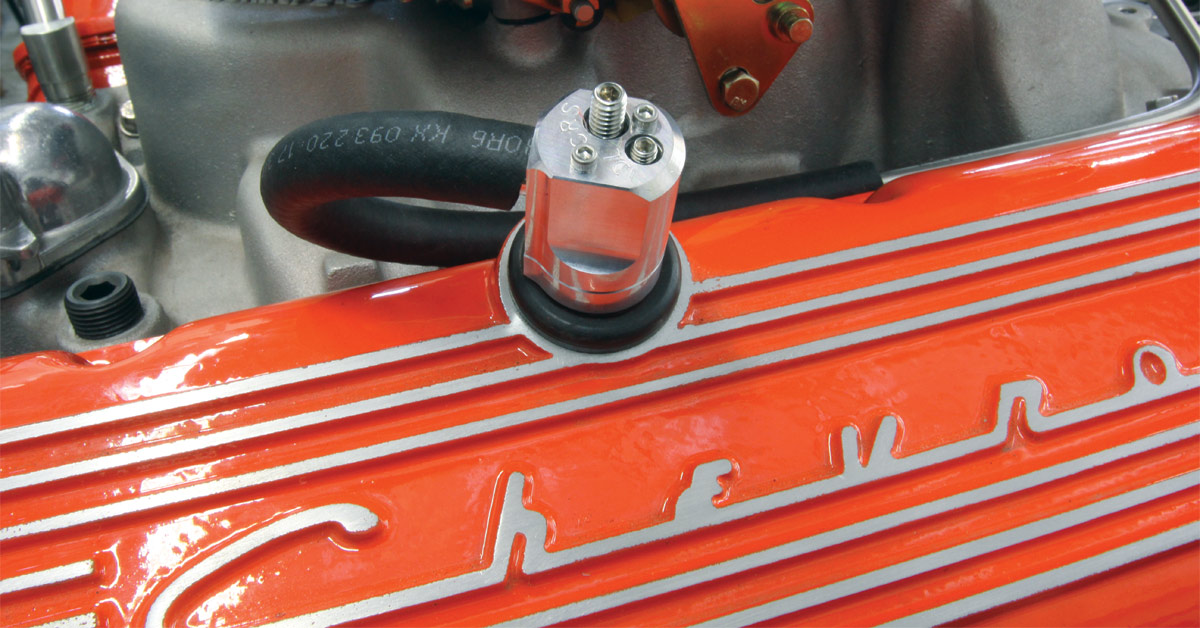
You do need a proper oil baffle under the PCV in the valve cover, and the PCV should be matched to engine vacuum. If you think it’s pulling oil up to the carb, just pop out the valve and hose and check for oil. If it’s oily inside, then consider using a catch can.

Using only two baffles in the valve covers is a bad idea. It relieves crankcase pressure, but no air flow through the crankcase does not vent moisture.
 

ChuckN

Full Access Member
Joined
Nov 8, 2022
Posts
2,082
Reaction score
7,636
Location
Bellinham, WA
First Name
Chad
Truck Year
1981
Truck Model
C10
Engine Size
350
It will be interesting to see how much vacuum I actually have. It won’t be anything near stock- some sort of 383 with a mild/moderate cam. So, somewhere around 13-15mmHg is my suspicion, but who knows.

Thanks for the recommendation @xm20k . The other variable is that M/T valve covers use a weird 1” Ford size for their PCV grommets, but who knows if I’ll be able to run them anyway- the baffles I fabricated might contact the poly locks on the rockers since they positioned them above the rockers rather than between them.

I like the idea of a catch can, even though I don’t need one, if only for the fact that I can visualize how much oil is coming up vs just having it go down the gullet.
 

Camar068

Supporting Member
Air Force Supporting Member
Joined
Feb 5, 2014
Posts
5,015
Reaction score
4,934
Location
Kentucky
First Name
David
Truck Year
1986
Truck Model
K10/LM7 5.3/4L60e/np208/3.73/32"
Engine Size
10 yrs Air Force
I've been looking at one for my LS install. Reading up on naturally aspirated vs vacuum assist, the only concern I have with naturally aspirated is you have to wait for it to get hot and build up pressure.

With how nasty the intake was when I did the swap, I installed a can and it was "catching" stuff, but relied on engine vacuum.

I'd like to take the intake out of the equation and use a pump. I just came across this but it's a GM brake booster vacuum pump.

If it will work, it will separate engine vacuum and the pcv system but still use vacuum for pcv.

12v Vacuum pump


You must be registered for see images attach
 
Last edited:

xm20k

Runs on 93 octane, caffeine, and spite
Supporting Member
Joined
May 26, 2025
Posts
1,109
Reaction score
2,847
Location
Girard, Ohio
First Name
David
Truck Year
78
Truck Model
c10
Engine Size
388
Some performance/race builds will use the exhaust to evac the crankcase.

xc_hide_links_from_guests_guests_error_hide_media
 

Bennyt

Full Access Member
Joined
May 17, 2019
Posts
1,613
Reaction score
2,921
Location
Surprise
First Name
Ben
Truck Year
1977
Truck Model
C10
Engine Size
350
mewagner.com

Best pcv on the market and plenty of technical info.
 

Ricko1966

Full Access Member
Joined
Apr 11, 2017
Posts
9,940
Reaction score
19,069
Location
kansas
First Name
Rick
Truck Year
1975
Truck Model
c20
Engine Size
350


You must be registered for see images attach
 

ali_c20

Supporting Member
Supporting Member
Joined
Sep 20, 2016
Posts
2,085
Reaction score
3,201
Location
Austria
First Name
Alexander
Truck Year
1974, 1979
Truck Model
C20, K5
Engine Size
350, 350
I will go out on a limb and say a catch can is not usually needed on an SBC with properly installed PCV system. There’s are 100s of thousands of stock and modified SBC engines without a catch can, and most are still working fine.

You do need a proper oil baffle under the PCV in the valve cover, and the PCV should be matched to engine vacuum. If you think it’s pulling oil up to the carb, just pop out the valve and hose and check for oil. If it’s oily inside, then consider using a catch can.

Using only two baffles in the valve covers is a bad idea. It relieves crankcase pressure, but no air flow through the crankcase does not vent moisture.
I have stock valve covers with baffles but still there is some oil and other stuff in the vapor that gets filtered out by the catch can.
PCV valve matches engine vacuum.
I don't know if it does any harm or carbs up any parts but I prefer do not have this stuff in my engine.
 

ChuckN

Full Access Member
Joined
Nov 8, 2022
Posts
2,082
Reaction score
7,636
Location
Bellinham, WA
First Name
Chad
Truck Year
1981
Truck Model
C10
Engine Size
350
Took the time to read that article @Ricko1966 - very good article. I even found the cheap Evil Energy Amazon catch can they used and it’s $40 with 5 feet of line. They even fabricated a cool bracket so they could mount it to the Brake booster and hide it behind it.

I believe it when they say that the testing with standard PCV valves make the system function very little. Other guys apparently use a fixed orifice “valve” that constantly flow, and they check the crankcase vacuum at the inlet breather aiming for 1-3” of mercury. apparently that’s the “middle of the road” approach when a guy doesn’t want to spend hundreds of dollars on the Wagner adjustable piece.
 

Terlingueno

Fictional Western Sage
Joined
Dec 29, 2020
Posts
443
Reaction score
1,580
Location
Far West Texas
First Name
Skeeter
Truck Year
1985
Truck Model
K20 Suburban-SM465
Engine Size
350
My original engine in the K20 Sub was an LT9 engine code M. The Goodwrench replacement is a 10067353 crate. The only changes I have made to the replacement are headers, Edelbrock 2101 intake, and an Eddy 1405 carb. The original LT9 called for ACDelco CV774C valve and I have a stash of those and they work fine in what I have at this point. I have a full flow breather on the passenger side valve cover. Anyone think these shouldn't work fine with what I have?
You must be registered for see images attach
 

ali_c20

Supporting Member
Supporting Member
Joined
Sep 20, 2016
Posts
2,085
Reaction score
3,201
Location
Austria
First Name
Alexander
Truck Year
1974, 1979
Truck Model
C20, K5
Engine Size
350, 350
My original engine in the K20 Sub was an LT9 engine code M. The Goodwrench replacement is a 10067353 crate. The only changes I have made to the replacement are headers, Edelbrock 2101 intake, and an Eddy 1405 carb. The original LT9 called for ACDelco CV774C valve and I have a stash of those and they work fine in what I have at this point. I have a full flow breather on the passenger side valve cover. Anyone think these shouldn't work fine with what I have?
You must be registered for see images attach
The vacuum of the old and new engines is in nearly the same I guess so it should work. Run it. My 0.02$
 

Latest posts

Forum statistics

Threads
48,401
Posts
1,066,571
Members
42,780
Latest member
blue10
Top