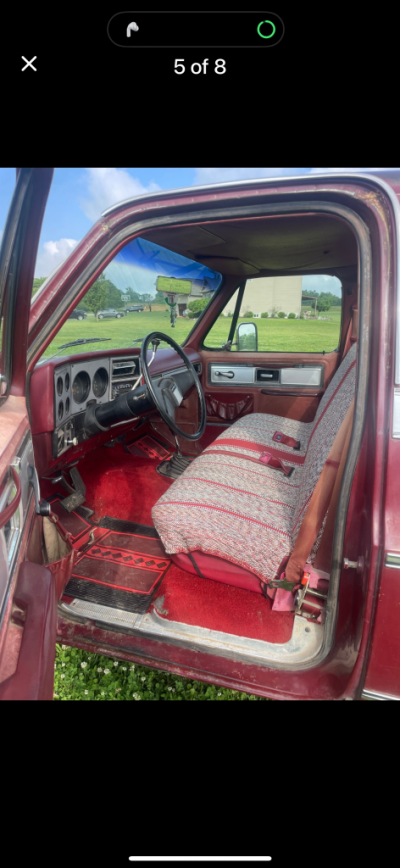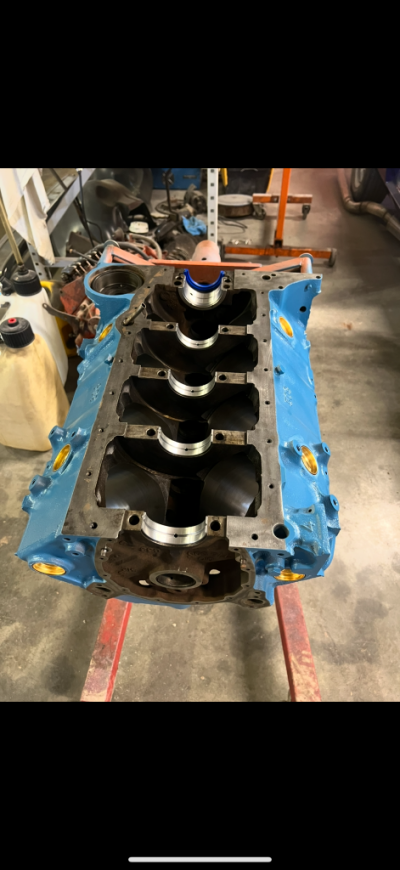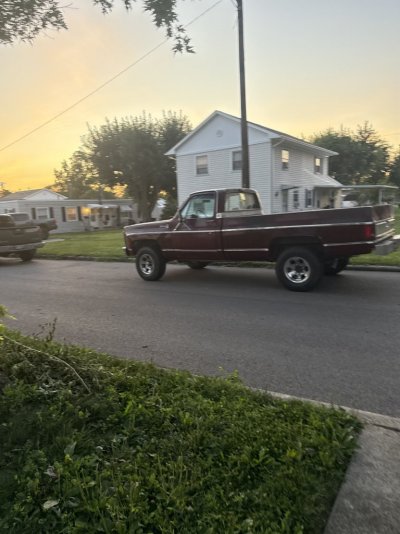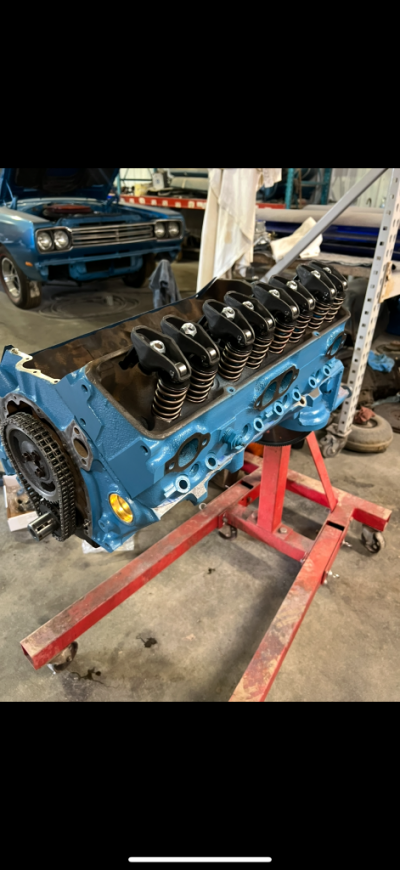
Stock 400 small bock with bigger cam

Disclaimer: Links on this page pointing to Amazon, eBay and other sites may include affiliate code. If you click them and make a purchase, we may earn a small commission.

Patman

Full Access Member
Joined
Jun 13, 2025
Posts
57
Reaction score
31
Location
Ohio
First Name
P.
Truck Year
85
Truck Model
K10
Engine Size
383
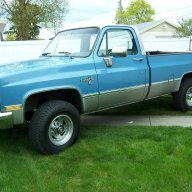
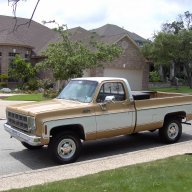
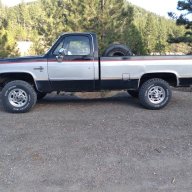
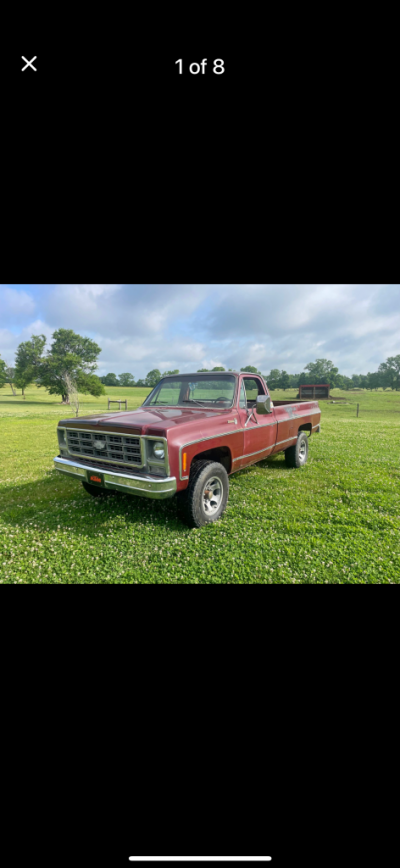
A few days ago I picked up a 79 K20 400/400th/203 Dana 44/14b-ff 8 lug with and A/C cab. Its running rich. Slow to start at times and will diesel when you shut it off. I started using high octane fuel and some of that cleared up. Still slow to start at times, I think the larger cam and poorly flowing stock heads are preventing a clean burn. I'm going to upgrade/update the ignition system to try to help with that but if the heads wont flow, they wont flow. Well, I'll update all but the distributor, before I start messing with the carb. To be clear, I'm not the carb guy...

Spoke to the guy who actually got the truck out of the barn and built the motor. He gave me the cam specs and the story on the truck. He replaced the rings and main bearings, lifters and springs. They put an ASV2 carb on it. The camshaft specs are below but the rest of the motor is stock. Was a sprayer on a farm. 28K miles on the odometer. The tank and sprayer were bolted in the bed., had long arms that would swing out. He said the truck sat in a barn for nearly 20 years before he rebuilt the engine, this year, and got the truck on the road. Going to college and wants a car.

Lift: .465/.488
Duration: 290/300
LSA: 112

I have a known good 99 vortec 5.7 that I can pull the heads from. Figure that I can clean them up, drill the steam ports, swap the springs and keepers, lap the valves if necessary and go. Am I missing anything?

I guess I'd have to measure for pushrods...

I really dont wana pull the engine to do this.

Have any of yall done this before, any experience here?

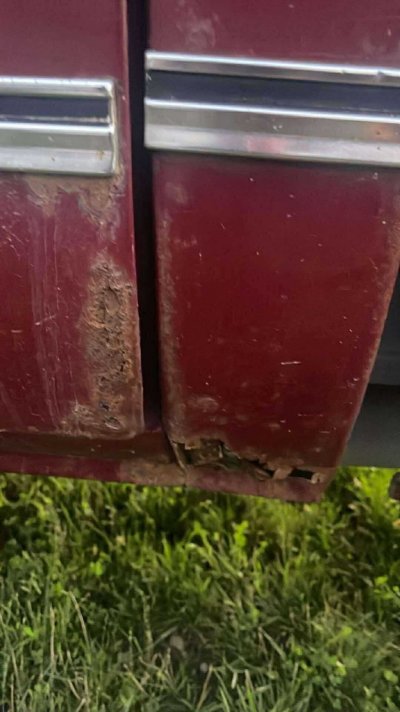
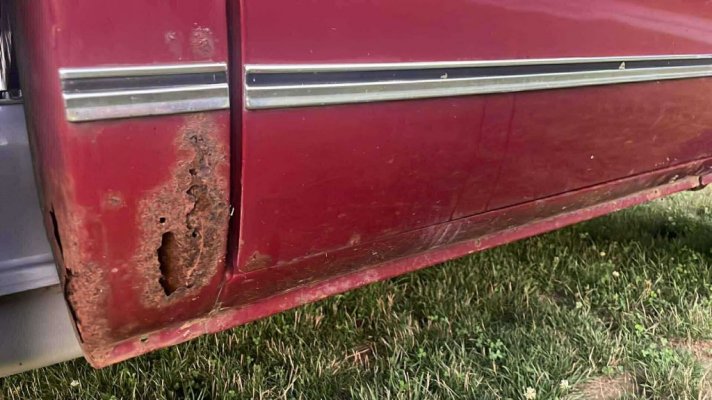
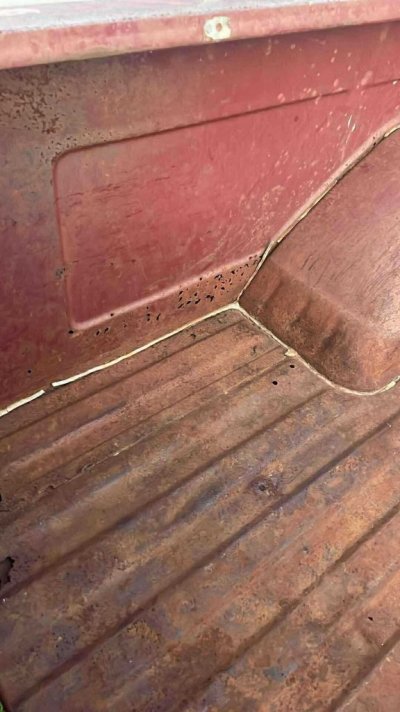
In the mean time I need to replace the steering gear box and figure out the brackets for the AC system. The window mechansim rattles in the door (cuz the door bottoms are rusted, but that's about it. A little rust to take care of in the rockers and cab corners but not much, considering.

I've ben wrenching for about 5 years but most of my work has been on Jeeps. I do have another squarebody that Im building but this was a good deal and I didn't want to pass it up. Point being, Im not that up to speed on chevy stuff yet.
 

Attachments

  • IMG_5140.png
    IMG_5140.png
    372.3 KB · Views: 87
  • IMG_5139.png
    IMG_5139.png
    589.2 KB · Views: 74
  • IMG_3427.png
    IMG_3427.png
    532.8 KB · Views: 75
  • IMG_5128.jpeg
    IMG_5128.jpeg
    140 KB · Views: 71
  • IMG_3426.png
    IMG_3426.png
    576 KB · Views: 78

Patman

Full Access Member
Joined
Jun 13, 2025
Posts
57
Reaction score
31
Location
Ohio
First Name
P.
Truck Year
85
Truck Model
K10
Engine Size
383
pics of the rust
 

Attachments

  • 09a0f2cc7cdcf8b22c819943bfce6d03.jpeg
    09a0f2cc7cdcf8b22c819943bfce6d03.jpeg
    93.1 KB · Views: 48
  • 490ab010aefa312f897963a6ae059267.jpeg
    490ab010aefa312f897963a6ae059267.jpeg
    125.9 KB · Views: 51
  • e5233434c6b8a7d30f8eb5a14ec77ba3.jpeg
    e5233434c6b8a7d30f8eb5a14ec77ba3.jpeg
    107.5 KB · Views: 54

fast 99

Full Access Member
Joined
Dec 31, 2021
Posts
2,576
Reaction score
4,084
Location
Spokane, Washington
First Name
Brian
Truck Year
81,85
Truck Model
K20
Engine Size
350
400's ran fine in stock form. HEI has all the ignition that motor needs. If you want to add to Jegs profit by all means order away. Think it through first.

I do agree if the heads need rebuilding consider aftermarket aluminum. If they are usable as is may be not.

Remember 400 has more swept volume. Very easy to raise compression to an unacceptable level.

Carb issues are never fixed with new heads.
 

Patman

Full Access Member
Joined
Jun 13, 2025
Posts
57
Reaction score
31
Location
Ohio
First Name
P.
Truck Year
85
Truck Model
K10
Engine Size
383
I’m not sure what heads are on it, (I’ll check) they are stock, but have been rebuilt with new springs pretty recently (3k miles?). It just has that larger cam. Which is what I think is causing it to run so rich.

Just not to sure where to start with the carb.
 

75gmck25

Full Access Member
Joined
Oct 13, 2016
Posts
2,756
Reaction score
3,047
Location
Northern Virginia
First Name
Bruce
Truck Year
1975
Truck Model
K25 Camper Special TH350 NP203
Engine Size
5.7
Stock heads are low compression and low flow, so they don’t play well with an aggressive duration cam.

The 350/290 hp GM crate is a good example, where they use a 222/222 @ .050 cam to get the engine HP up from the cam used in the base 350/250 HP crate. It works, but loses low end torque, and it does not get much additional power until rpm is up high. It’s not a good match for a heavy truck and/or daily driver unless you have gears to get the rpm up quickly.

In your case the stock HEI should work fine, so don’t spend money on something more exotic. As a simple change, you might try setting base timing to about 16 BTDC and see how it feels. Then verify you get 18-20 degrees more from your mechanical advance, and take it for a run. If you get pinging at light throttle you might have to back off on base timing, or get a vacuum advance that adds less cruise timing.

Make sure the carburetor linkage is working to get full throttle, and you get the secondaries to kick in, and then verify the accelerator pump is working. Check transfer slot exposure and make sure you are about half exposed at idle position, and then use the mixture screws to set the idle. You need that setup to get a smooth transition from idle to mid range throttle.

Rebuilding heads will make it run smoother, but they are still the same old low compression heads. For a daily driver with moderate gearing, they would work better with a cam duration of no more than about 212-214 @ .050. Aluminum heads with smaller 64cc chambers are the best solution, but that’s a fairly expensive upgrade.
 

bucket

Super Moderator
Staff member
Moderator
Joined
Aug 3, 2010
Posts
35,111
Reaction score
43,672
Location
Usually not in Ohio
First Name
Andy
Truck Year
'77, '78, '79, '84, '88
Truck Model
K5 thru K30
Engine Size
350-454
Stock heads are low compression and low flow, so they don’t play well with an aggressive duration cam.

The 350/290 hp GM crate is a good example, where they use a 222/222 @ .050 cam to get the engine HP up from the cam used in the base 350/250 HP crate. It works, but loses low end torque, and it does not get much additional power until rpm is up high. It’s not a good match for a heavy truck and/or daily driver unless you have gears to get the rpm up quickly.

In your case the stock HEI should work fine, so don’t spend money on something more exotic. As a simple change, you might try setting base timing to about 16 BTDC and see how it feels. Then verify you get 18-20 degrees more from your mechanical advance, and take it for a run. If you get pinging at light throttle you might have to back off on base timing, or get a vacuum advance that adds less cruise timing.

Make sure the carburetor linkage is working to get full throttle, and you get the secondaries to kick in, and then verify the accelerator pump is working. Check transfer slot exposure and make sure you are about half exposed at idle position, and then use the mixture screws to set the idle. You need that setup to get a smooth transition from idle to mid range throttle.

Rebuilding heads will make it run smoother, but they are still the same old low compression heads. For a daily driver with moderate gearing, they would work better with a cam duration of no more than about 212-214 @ .050. Aluminum heads with smaller 64cc chambers are the best solution, but that’s a fairly expensive upgrade.

We don't know the compression ratio. It's been rebuilt and cam swapped. Increased compression ratio is just as safe of an assumption as stock compression ratio. But even with that aside, running rich is a tuning issue. Too much cam for heads and compression (which we don't know that it is) is a power/economy issue.
 

xm20k

Runs on 93 octane, caffeine, and spite
Supporting Member
Joined
May 26, 2025
Posts
1,110
Reaction score
2,852
Location
Girard, Ohio
First Name
David
Truck Year
78
Truck Model
c10
Engine Size
388
If its stock internals ie pistons and rods than they are going to be dished probably also sit down in the hole up to .025 so with a 76cc head around 8:1 and with a 64 around 9:1 roughly, bump those numbers up 1 point for slight surfacing and flat tops.
Those are advertised durations not actual. My advertised is 314 actual is 252. With those numbers probably in the 230-235 range actual and with 112 lobe sep basically an RV/towing cam.

Most likely this a carb/timing setup/tuning issue.
 

andybflo

Member
Joined
Aug 13, 2020
Posts
40
Reaction score
78
Location
Western NY
First Name
Andrew
Truck Year
1986
Truck Model
C-10 Silverado
Engine Size
5.3 LM7/4L60E
A few days ago I picked up a 79 K20 400/400th/203 Dana 44/14b-ff 8 lug with and A/C cab. Its running rich. Slow to start at times and will diesel when you shut it off. I started using high octane fuel and some of that cleared up. Still slow to start at times, I think the larger cam and poorly flowing stock heads are preventing a clean burn. I'm going to upgrade/update the ignition system to try to help with that but if the heads wont flow, they wont flow. Well, I'll update all but the distributor, before I start messing with the carb. To be clear, I'm not the carb guy...

So... Before you remove, upgrade, or change out anything let's get your start/runtime/idle issues sorted.

First things first, do you have the manual for the AVS? If not, go download it. Edelbrock legitimately has a pretty well written short book on carb theory, and how to tune it.

Your dieseling is from one of two things, too high an idle, or your idle slots are over exposed.

Your slow/sluggish off start can be the same.

What's your baseline timing? Where's your timing vacuum, ported or manifold vacuum?

At idle how much vacuum are you pulling? Have you set idle mixture (it can solve more than you think.)

Start by reading ilde vacuum, and idle speed/mixture, and next, make it hard (turn the screw on the air door) for your secondary to open. It may seem counterintuitive, but more often than not people set those to tip in too early, and the car bogs. Which I'm betting is the case here. Lean makes power.

Set baseline mixture. Turn both screws all the way in, bring them both out 1.75 turns. Turn them in in 1/8 turn increments for max idle speed. Once that's reached, turn them back out a 1/4 turn.

Get a timing reading vacuum disconnected. Set idle speed, so out of gear your ~700 RPM.

Fine tune your idle mixture. Then plug in your timing vacuum line try for manifold. Tough to tell how it's tuned (factory in that era is probably ported, but, who knows what has happened in four decades to the HEI.)

Don't waste your money on aftermarket ignition parts. The limiting factor for combustion efficiency on a Gen1 SBC isn't voltage, it's 70yo combustion chamber design.

Get it running right. Then figure out upgrades. If you do it the other way, you're just making it worse.

Fix idle and baseline timing. Then primary rich/lean transition. Last dial in secondary and air door opening.

If you don't know what that means, read the Edelbrock manual. It'll lay out baseline theory pretty well.

Let me know the timing specs, vacuum at idle, and how you make out in step one.

If you don't own a timing light and vacuum gauge, invest in those before new heads.
 

Ricko1966

Full Access Member
Joined
Apr 11, 2017
Posts
9,945
Reaction score
19,076
Location
kansas
First Name
Rick
Truck Year
1975
Truck Model
c20
Engine Size
350
I’m not sure what heads are on it, (I’ll check) they are stock, but have been rebuilt with new springs pretty recently (3k miles?). It just has that larger cam. Which is what I think is causing it to run so rich.

Just not to sure where to start with the carb.
It's the tune not the cam,not the heads causing it to run rich,and that is a baby cam,not enough there to worry about.Lots of trucks came factory with cams just about that size,and l82s and zz3s,zz4s are running more cam than that. Off the top of my head just for reference. The 929 cam factory,in goodwrench replacement and 250hp GM 350 crate. Tons of Impalas,trucks etc. 929 cam was .390 .410 lift 194 202 duration 112 lsa. That's from memory I'll see if I can find specs and double check. But you don't have enough cam to cause any problems with anything. That cam would work good in a 305, and the bigger the engine the more it tames the cam,that 400 doesn't even know it's got a bigger cam. Edit. The duration is 194/195 ( depending on what manufacturer you believe) intake,202 exhaust . Other specs were correct. 1st thing do,a good a good basic tuneup,check distributor advance condition centrifugal and vacuum,at least check condition of cap rotor,plugs,and wires,check end to end resistance on all plug wires,are they all close? Check for vacuum leaks and set your mixture and idle speed. If it's idling on the transition circuit because someone doesn't know how to set up a carb it will run rich and stumble. I apologize I misread your cam specs. It is bigger than a 929 but not much bigger than l82,350 which ran junk heads low compression and a quadrajet 1972 and later. The cam and heads still aren't your problem,but the cam is bigger than I first realized.
 
Last edited:

Patman

Full Access Member
Joined
Jun 13, 2025
Posts
57
Reaction score
31
Location
Ohio
First Name
P.
Truck Year
85
Truck Model
K10
Engine Size
383
This is why I posted this before I did anything. Exactly the help I was hoping for. I’m gonna be outa town for a week. Once I get back, I’ll be doing some tuning. Thanks!
 

racprops

Junior Member
Joined
Dec 22, 2023
Posts
18
Reaction score
18
Location
Phoenix AZ
First Name
Richard
Truck Year
1993
Truck Model
G20 Van
Engine Size
383
I will add my 2cents worth, first the AVS carb is a remade old Charter AFB, a good OLD carb I was running on in the 60s, easy to work on...if that is any help. Edelbrock also did/does a performener version as well.

This were a good torque monsters with a torque peak at 2000 RPMs which can be mild on fuel if you can run at 1500 to 2000 on the highway.

Here is some specs:

The 400 was never built as a performance engine. It was a work engine used in heavy trucks, bus, vans, dump trucks etc.

HP is low stock in the 150-185 HP but had alot of torque.

1976 400 R4carb, 8.5:1 compression, 175HP @ 3600 rpm, 305 lbs ft torque @ 2000

The corvette 350 for that year

1976 350 R4carb, 9:1 compression, 210HP @ 5200 , 255 ft lbs @ 3600

'76 350 for like the camaro

1976 350 R4carb, 8.5:1 compression, 185HP @ 4000 , 270 ft lbs @ 2400

So if you want a strong truck I suggest you build for it, closer to stock.

Rich
 

mtbadbob

Supporting Member
Supporting Member
Joined
May 9, 2021
Posts
849
Reaction score
1,438
Location
Montana
First Name
Bob
Truck Year
1987
Truck Model
V20
Engine Size
350
FWIW, I had a '76 Monte w/sb 400, and it ran best at 12 degrees btdc, and F/A screws out almost 5 turns on a Quadrajet. This was in Montana, higher elevation. It was bone-stock, & I mainly timed & tuned by ear, and of course I flipped over the air cleaner lid! It was a very strong runner for what it was, and I could pull 22-24 mpg out of that boat. My uncle had a '77 K20 with the 400, and it was kind of a dog in stock form, but I'm not sure how closely those truck vs car engines were, on top of him packing a bit more weight. I've owned many sbc's & that 400 was probably one of my fav's.
 

Latest posts

Forum statistics

Threads
48,413
Posts
1,066,802
Members
42,793
Latest member
clawson255
Top