
Tuning chart Edelbrock 1400

Disclaimer: Links on this page pointing to Amazon, eBay and other sites may include affiliate code. If you click them and make a purchase, we may earn a small commission.

75gmck25

Full Access Member
Joined
Oct 13, 2016
Posts
2,756
Reaction score
3,047
Location
Northern Virginia
First Name
Bruce
Truck Year
1975
Truck Model
K25 Camper Special TH350 NP203
Engine Size
5.7
if you want to start at the beginning for your tuning I would try a few things first.
- buy a dialback timing light with a tachometer. I am using one from Innova, but there are several other brands.
- use a piston stop (home-made or purchased) and verify TDC for #1. Move the timing pointer or remark the balancer if needed. GM used multiple balancers and timing pointers, and someone may have mixed them up.
- 16 degrees is pretty high for base timing, but it should work. Most factory engines are set to about 4-8. I do use 15-16 on my SBC with aluminum heads.
- verify that you get an additional 18-20 degrees of mechanical by about 3000 rpm. If there is an advance weights kit installed it may advance faster and come in at a lower rpm.
- pull vacuum on the advance can and verify it adds adds about 18-20 degrees (stock can) or maybe lower if it’s been modified
-determine if you have a full vacuum and timed vacuum port on the carburetor. Either one should work fine, but make sure the port you use will have vacuum at cruise RPM. The vacuum advance is only there to improve gas mileage, so you can set everything else up and pick timed vs. manifold ports later on.

Once you get all that verified, start on the carburetor.

 

Ricko1966

Full Access Member
Joined
Apr 11, 2017
Posts
9,947
Reaction score
19,081
Location
kansas
First Name
Rick
Truck Year
1975
Truck Model
c20
Engine Size
350
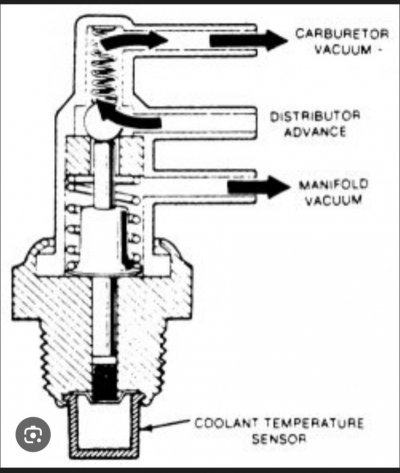
I will disagree with the comnent about vacuum advance is only there for milage,but I don't want to get into it. There is reason GM used a thermovacuum switch that changed default from ported to manifold vacuum once a certain temperature was reached.
 

elbpony

Full Access Member
Joined
Jul 19, 2025
Posts
95
Reaction score
123
Location
Germany
First Name
Tim
Truck Year
1974
Truck Model
C10 Custom Fleetside
Engine Size
350cui 4BBL
Bruce, that is the majority of steps I did leading me to posting my findings.

Dialback timing I have and use.
TDC is checked and good.

The carb has no full vacuum, only ported and that on both sides. As I want to have full manifold vacuum I am sure I will have to get a new carb. Rick´s post reflects exactly what I know as well and what I base my engine on. The manifold vacuum always worked best for me on my 302 ford and why should it not for the chevy.

centrifugal advance introduced by the HEI is there. Yet I can´t see the timing mark above 2000rpm. Could be me worn out old poor eyesight, but the whole picture down there at the balancer gets so quick flickering I can´t see a clear thing. At 2000rpm (+/- of course) the advance is at 26-28°, no vacuum advance of course)

Vacuum advance as such is fine, checked the can with a vacuum suction device. Don´t know the word for it...like hand pumpt that holds the vacuum for a steady reading.

What gives me a headache is why the timing retards to approx 6° after TDC for this very short moment when opening throttle. That seems unhealthy. It comes back to a realistic BTDC timing after like half a second.

There are no vacuum leaks I could find. Spraying start pilot carefully across the carbs base and spacer base did not change and rpm. Hoses are all good strong.
 

75gmck25

Full Access Member
Joined
Oct 13, 2016
Posts
2,756
Reaction score
3,047
Location
Northern Virginia
First Name
Bruce
Truck Year
1975
Truck Model
K25 Camper Special TH350 NP203
Engine Size
5.7
If you are seeing the timing retard as rpm goes up, and then advance again, there may be an internal problem with the distributor. It’s probably worth your time to borrow another light and see if you get the same readings.

I prefer to manifold vacuum, but you should be able to make minor changes to your tuning and use ported. I like the additional advance at idle because it keeps the engine speed up when A/C is on. However, my 80’s vintage Quadrajet does not seem to have a ported vacuum connection, so it’s kind of a moot point for me.

I can also explain my oversimplified comment about vacuum advance and gas mileage. An engine can run/perform fine without vacuum advance, and many race-only engines don’t bother using one. However, if you disable it on a street engine it will definitely affect your gas mileage. The one challenge is that sometimes when you adjust base and mechanical for best performance, a stock 20 degree vacuum advance is too much and you get pinging at light throttle cruise. That is the reason some folks install limit pins or buy a can where you can adjust the vacuum point where it starts to come in.
 
Last edited:

Vbb199

B-rate Hillbilly Customs
Joined
Jan 12, 2018
Posts
9,647
Reaction score
16,853
Location
Salisbury NC
First Name
Vince
Truck Year
89, 79
Truck Model
89 Suburban R1500, 79 C10
Engine Size
350, 502
Goober, thanks.
I know I have nothing relevant to add to this thread....

Bu i'll be honest, I had to turn my phone sideways and see Sad Sack's name because when I first read this, I thought damn why's he calling this guy a goober lol

(Names and profile info arent show my mobile unless you turn the phone sideways)
 

Ricko1966

Full Access Member
Joined
Apr 11, 2017
Posts
9,947
Reaction score
19,081
Location
kansas
First Name
Rick
Truck Year
1975
Truck Model
c20
Engine Size
350
Bruce, that is the majority of steps I did leading me to posting my findings.

Dialback timing I have and use.
TDC is checked and good.

The carb has no full vacuum, only ported and that on both sides. As I want to have full manifold vacuum I am sure I will have to get a new carb. Rick´s post reflects exactly what I know as well and what I base my engine on. The manifold vacuum always worked best for me on my 302 ford and why should it not for the chevy.

centrifugal advance introduced by the HEI is there. Yet I can´t see the timing mark above 2000rpm. Could be me worn out old poor eyesight, but the whole picture down there at the balancer gets so quick flickering I can´t see a clear thing. At 2000rpm (+/- of course) the advance is at 26-28°, no vacuum advance of course)

Vacuum advance as such is fine, checked the can with a vacuum suction device. Don´t know the word for it...like hand pumpt that holds the vacuum for a steady reading.

What gives me a headache is why the timing retards to approx 6° after TDC for this very short moment when opening throttle. That seems unhealthy. It comes back to a realistic BTDC timing after like half a second.

There are no vacuum leaks I could find. Spraying start pilot carefully across the carbs base and spacer base did not change and rpm. Hoses are all good strong.
Cap your vacuum ports on the carb install a vacuum tree somewhere on the manifold. Then hook your transmission and vacuum advance to the manifold. As for engines running fine just poor milage with vacuum advance. Not true that's why manufacturers have installed it for decades,and decades the advance needs change at idle,different engine speeds,and different engine loads,and vacuum is an easy way to monitor this,its like a primative ecm. Race cars don't need vacuum advance,and it wouldn't work of they had it,there is no vacuum at higher throttle openings. All factory cans do not provide the same amount of vacuum advance,some provide very little,some provide a bunch,they also don't all come in and drop out at the same vacuum rating. Most if not all adjustable vacuum advances are a very poor substitute for a properly rated can and a limiter if needed. The way most if not all adjustable cans work is they have a spring that creates more and more tension as you tighten it limiting the amount of advance because the vacuum can't overcome the spring tension. Great except now you have a can that is non responsive because it's bound up by a spring and can't move as freely or at the hg rating that it needs too,not just at the end of the range,but the entire range. Cranes kits used to come with an adjustable can but the spring tension in the can was only to adjust what vacuum reading the can started moving at. It came with an adjustable limit plate to control the amount of advance possible.MSD manufactures those also. The shift started coming when manufacturers started using price point and the consumers buying that way,so now everyone just buys the adjustable can but 90 percent of the time it's not being used correctly. The adjustment is for vacuum rating,not degree limiting. Race cars get away with no vacuum advance and sometimes no centrifugal either because they are timed for total timing and are 99 percent of the time in the RPM range that they can use that timing. They spend very little timing lugging around in traffic,very little time idling,very little time at part throttle cruise. Not having proper timing at the lower speeds creates more heat and dirty plugs,as well as poor milage. Auto manufacturers came out with this handy little gadget to cure running hot at low speed with ported vacuum advance. If the engine starts running above a specified temperature it changes the vacuum source from ported to manifold vacuum,to cool the engine. Because sometimes at low speeds the engine needs the extra timing.
 

Attachments

  • Screenshot_2025-10-01_082410.jpg
    Screenshot_2025-10-01_082410.jpg
    88.7 KB · Views: 34
Last edited:

elbpony

Full Access Member
Joined
Jul 19, 2025
Posts
95
Reaction score
123
Location
Germany
First Name
Tim
Truck Year
1974
Truck Model
C10 Custom Fleetside
Engine Size
350cui 4BBL
Cap your vacuum ports on the carb install a vacuum tree somewhere on the manifold. Then hook your transmission and vacuum advance to the manifold. As for engines running fine just poor milage with vacuum advance. Not true that's why manufacturers have installed it for decades,and decades the advance needs change at idle,different engine speeds,and different engine loads,and vacuum is an easy way to monitor this,its like a primative ecm. Race cars don't need vacuum advance,and it wouldn't work of they had it,there is no vacuum at higher throttle openings. All factory cans do not provide the same amount of vacuum advance,some provide very little,some provide a bunch,they also don't all come in and drop out at the same vacuum rating. Most if not all adjustable vacuum advances are a very poor substitute for a properly rated can and a limiter if needed. The way most if not all adjustable cans work is they have a spring that creates more and more tension as you tighten it limiting the amount of advance because the vacuum can't overcome the spring tension. Great except now you have a can that is non responsive because it's bound up by a spring and can't move as freely or at the hg rating that it needs too,not just at the end of the range,but the entire range. Cranes kits used to come with an adjustable can but the spring tension in the can was only to adjust what vacuum reading the can started moving at. It came with an adjustable limit plate to control the amount of advance possible.MSD manufactures those also. The shift started coming when manufacturers started using price point and the consumers buying that way,so now everyone just buys the adjustable can but 90 percent of the time it's not being used correctly. The adjustment is for vacuum rating,not degree limiting. Race cars get away with no vacuum advance and sometimes no centrifugal either because they are timed for total timing and are 99 percent of the time in the RPM range that they can use that timing. They spend very little timing lugging around in traffic,very little time idling,very little time at part throttle cruise. Not having proper timing at the lower speeds creates more heat and dirty plugs,as well as poor milage. Auto manufacturers came out with this handy little gadget to cure running hot at low speed with ported vacuum advance. If the engine starts running above a specified temperature it changes the vacuum source from ported to manifold vacuum,to cool the engine. Because sometimes at low speeds the engine needs the extra timing.
So, you suggest I should start truck racing to avoid any further vacuum trouble? Let me discuss that at home
 

elbpony

Full Access Member
Joined
Jul 19, 2025
Posts
95
Reaction score
123
Location
Germany
First Name
Tim
Truck Year
1974
Truck Model
C10 Custom Fleetside
Engine Size
350cui 4BBL
Ladies and gents
I have now checked the internal of my distributor. The mechanism moves freely and the weights get pulled back by the springs. With the finger on, the rotor i believe its called, i can twist by hand and the springs turn it back.
Springs and weights look a bit rusty and old, replacement on the way

Is it normal that i can rotate the rotor in the other direction a slight bit? Like against the direction it normaly operates? Just a few mm but some travel is there. Could that result in my shortterm spark retard from 16 before to 6 after tdc? The adavance gets back to where it should be almost instantly with both, getting of the throttle or keeping revs up.

Another thing i found was the metering rod not going up when opening the throttle. What I did was warm engine, the covers of the metering rods open that i can see the rods. The rods are sucked down. When opening throttle to 1500rpm and also at shortly heavier opening the rods stay down. In my theory, shouldn't these come up due to less vacuum? The springs are orange.

Don't know what vac the engine pulls, i am still waiting for my vacuum fitting for the manifold.
 

elbpony

Full Access Member
Joined
Jul 19, 2025
Posts
95
Reaction score
123
Location
Germany
First Name
Tim
Truck Year
1974
Truck Model
C10 Custom Fleetside
Engine Size
350cui 4BBL
If any is interested, I made progress.

I changed weights, base plate and springs in the distributor.
The old weights were pretty rusty but seemd to work.
The old springs were same pretty rusty.
The new set I have is an MSD #8428.
I installed the light spring aiming for early advance.

To my disappointment, the timing still jumped to after tdc, just as before with the old kit installed.
Anyway, I had to dial the timing back, the previous 16° were now 25 BTDC or so. I got it down to 12 now at idle with no vacuum hooked up. Still on the high side, but better than 16.

Anyway, as I had the filter of the carb I wanted to use the occasion and put pink instead of orange springs in it. The rods weren´t moving up at all when stepping on the gas. Not a tiny bit, even when hitting it really hard.

What can i say, the truck is a different one now. I checked the timing once more and suddenly it was there where it should be. A slight tip in did not end anymore in retard, instead the mark travels towards 36° at 2500 rpm, back and forth with no hesitation or false moves.
I have no clue what a pink step up spring could have to do with it, but that was at least a timely coincidence. Anyway, hooked the vac up at ported, still missing the manifold vac adapter, and took of for a test drive. And yes, it really is a different truck now. Very responsive and eager to obey my right foot. It is even more agile than my mustang. A great fun to drive.

I got gas on the way and made 19 l/100km, which is rough 12,4 mpg. Very well, especially considering that the engine was asking a lot of throttle to accelerate. I am very happy right now. Very pleased with my catalina blue. I hope to get that vacuum adapter real soon and than to get finish that construction site for now.
 
Last edited:

chutoi

Junior Member
Joined
Nov 30, 2025
Posts
2
Reaction score
2
Location
Algerie
First Name
linda
Truck Year
2020
Truck Model
Mercedes-Benz Unimog 406 4x4 1
Engine Size
7 liters
Hey, I don't have the exact chart for the 1400, but on my 1403 I used the Edelbrock #1477 kit with springs + rods — it fixed the acceleration bug well.
I'll look in my docs and I can share the chart 1400 with you if I find it.

 
Last edited:

elbpony

Full Access Member
Joined
Jul 19, 2025
Posts
95
Reaction score
123
Location
Germany
First Name
Tim
Truck Year
1974
Truck Model
C10 Custom Fleetside
Engine Size
350cui 4BBL
Hey, I don't have the exact chart for the 1400, but on my 1403 I used the Edelbrock #1477 kit with springs + rods — it fixed the acceleration bug well.
I'll look in my docs and I can share the chart 1400 with you if I find it.

That's nice of you, i gotbit sorted out w/o chart though. Necessity to change the spring was easy to find and with luck i guess the pink one made it.
 

Latest posts

Forum statistics

Threads
48,413
Posts
1,066,825
Members
42,795
Latest member
MRmolash
Top