

What have you done to your square lately??

Disclaimer: Links on this page pointing to Amazon, eBay and other sites may include affiliate code. If you click them and make a purchase, we may earn a small commission.

Sad Sack

Supporting Member
Supporting Member
Joined
Sep 3, 2024
Posts
2,620
Reaction score
5,492
Location
Nebraska
First Name
Goober
Truck Year
1985
Truck Model
C15
Engine Size
305
Another 'what have you done for your square body' thing. Putting together a 'go bag' that will live by the front door where I have to see it. When I am going to drive the K20, I'll take the bag with me each time, and put it back in the hovel when I return. Some of the things have lithium batteries and when it gets to be 100+ degrees for six months of the year, I don't want to leave em in the truck subject to heat abuse.

Found an old canvas medium size tool bag. Contents will be, for now:

The M12 1/2" impact wrench/battery and 7/8" socket for lug nut stuff, a few more sizes when I obtain them
My NOCO GB50 jump pack
Multimeter
Amp clamp thingy
Lithium AAA and AA batteries
A couple LED work lights
Can of carb cleaner and brake cleaner
A Middle of Nowhere liquid transfer shaker syphon thingy

A set of wrenches, screwdrivers, sockets, hammers, pliers and stuff already live in the truck, got a beefy set of jumper cables in there as well. Also my VIAIR and Safety Seal tire plugger. Just want to keep the electronics/lithiums out of the heat

Bag is appx 10" wide, 10" tall and 20" long

Anything else you reckon would be good to keep in the sack that needs to be there I am forgetting?
MREs
 

Goldie Driver

Full Access Member
Joined
Mar 19, 2018
Posts
4,374
Reaction score
7,551
Location
Houston, Texas
First Name
Britt
Truck Year
1980
Truck Model
GMC K1500 Suburban
Engine Size
350
Well, I had a flash of inspiration on the way in regarding the vacuum for the distributor advance at WOT. When using manifold vacuum, it disappears. Hmmm. What happens if you put a check valve in ?

So, I tried it. Had to reinstall the valve as I had it backwards the 1st time. :anitoof:

Interesting - it did not have the TA DA !!! effect at WOT I thought it would. It probably is a little better, and seems to be eliminating to puff of something ( raw fuel , maybe ? ) I was seeing out the tail pipe in car headlights at night.

Testing will continue.

I am going to answer my own question !

The check valve allows vacuum to open it, and you can blow thru it the opposite direction since you are forcing the check open similar to the vacuum pulling it open. ( Try it !! It's kind of counter intuitive ... :think: )

At any rate, you would think that it would allow the vacuum to be released as needed since the vacuum actuator would 'push' the vacuum back out.

Well, NO. :eek:

I pulled the line off the distributor and heard it pop. Hmmm. Hooked a gauge in line and fired it up - say 20" of vacuum at idle. Revved it.

It ADDED to the reading on the gauge and never went down.

Also not what I expected ...

Back to the drawing board.
 

Attachments

  • sddefault.jpg
    sddefault.jpg
    46 KB · Views: 30

Bextreme04

Supporting Member
Supporting Member Army
Joined
May 13, 2019
Posts
4,826
Reaction score
6,530
Location
Oregon
First Name
Eric
Truck Year
1980
Truck Model
K25
Engine Size
350-4bbl
I am going to answer my own question !

The check valve allows vacuum to open it, and you can blow thru it the opposite direction since you are forcing the check open similar to the vacuum pulling it open. ( Try it !! It's kind of counter intuitive ... :think: )

At any rate, you would think that it would allow the vacuum to be released as needed since the vacuum actuator would 'push' the vacuum back out.

Well, NO. :eek:

I pulled the line off the distributor and heard it pop. Hmmm. Hooked a gauge in line and fired it up - say 20" of vacuum at idle. Revved it.

It ADDED to the reading on the gauge and never went down.

Also not what I expected ...

Back to the drawing board.
Not sure what you are trying to do here, but you don't want more timing at WOT. You want 32-36 degrees of timing at WOT with most older SBC and BBC heads. Aluminum fast burn chambers in modern heads will generally want less timing because the combustion happens faster and more efficiently. You want more timing at lean and low load conditions. Generally what I find works well for older SBC engines is 8-12 degrees initial, 22 Degree mechanical advance that comes all in by ~2500-3000 RPM, and an adjustable vacuum advance set to 8-12 degrees of additional advance. That vacuum advance will depend greatly on what your cruise RPM is and how healthy the engine is. You generally will want something like 40-50 degrees of advance at low load cruise with the engine running slightly lean or EGR coming on.

You definitely DO NOT want the distributor vacuum advance to stay engaged when you lose engine vacuum. You want the timing to come back down to no more than ~12 degrees for starting and then let it increase when the engine has started and is pulling vacuum. You want the vacuum advance to fall off when you go full throttle so you aren't detonating at high load and rich conditions.
 

Chevrolado

Full Access Member
Joined
Dec 13, 2012
Posts
903
Reaction score
1,905
Location
McKinney, TX
First Name
Dave
Truck Year
1977|2006
Truck Model
K10|1500
Engine Size
5.7|5.3
Did you measure it? if so how long from end to end?
I actually didnt measure it. Should have though as I recall reading conflicting information as I ordered it.. I still have my OE one though, maybe I'll measure it for the heck of it.

You must be registered for see images attach

the
 

Goldie Driver

Full Access Member
Joined
Mar 19, 2018
Posts
4,374
Reaction score
7,551
Location
Houston, Texas
First Name
Britt
Truck Year
1980
Truck Model
GMC K1500 Suburban
Engine Size
350
Not sure what you are trying to do here, but you don't want more timing at WOT. You want 32-36 degrees of timing at WOT with most older SBC and BBC heads. Aluminum fast burn chambers in modern heads will generally want less timing because the combustion happens faster and more efficiently. You want more timing at lean and low load conditions. Generally what I find works well for older SBC engines is 8-12 degrees initial, 22 Degree mechanical advance that comes all in by ~2500-3000 RPM, and an adjustable vacuum advance set to 8-12 degrees of additional advance. That vacuum advance will depend greatly on what your cruise RPM is and how healthy the engine is. You generally will want something like 40-50 degrees of advance at low load cruise with the engine running slightly lean or EGR coming on.

You definitely DO NOT want the distributor vacuum advance to stay engaged when you lose engine vacuum. You want the timing to come back down to no more than ~12 degrees for starting and then let it increase when the engine has started and is pulling vacuum. You want the vacuum advance to fall off when you go full throttle so you aren't detonating at high load and rich conditions.

Trying to understand why it has so little ooomph at highway speeds and thought maybe if it had additional advance it would help. I am also trying to figure out why it throws some sort of smoke under WOT w/ the EGR hooked up but not without. Maybe that is the residual exhaust from the EGR being shoved out ? Maybe too rich at WOT ? Dunno. No cat, so I can see it when it happens.

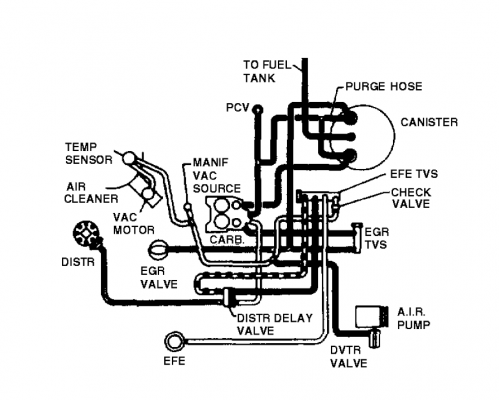
Additionally, if you look at the vacuum diagram it appears they have a check in there. It is different than the usual one, though, as it allows for 2 sources of vacuum. It is called a delay valve in the pic but it is a check schematically. I think it allows manifold vac under hot conditions at idle but can't quite tell you how that works ...

maybe the TVS opens MORE after a certain temp ? :think:
 

Attachments

  • Vacuum Routing.PNG
    Vacuum Routing.PNG
    68.2 KB · Views: 29
Last edited:

Bextreme04

Supporting Member
Supporting Member Army
Joined
May 13, 2019
Posts
4,826
Reaction score
6,530
Location
Oregon
First Name
Eric
Truck Year
1980
Truck Model
K25
Engine Size
350-4bbl
Trying to understand why it has so little ooomph at highway speeds and thought maybe if it had additional advance it would help. I am also trying to figure out why it throws some sort of smoke under WOT w/ the EGR hooked up but not without. Maybe that is the residual exhaust from the EGR being shoved out ? Maybe too rich at WOT ? Dunno. No cat, so I can see it when it happens.

Additionally, if you look at the vacuum diagram it appears they have a check in there. It is different than the usual one, though, as it allows for 2 sources of vacuum. It is called a delay valve in the pic but it is a check schematically. I think it allows manifold vac under hot conditions at idle but can't quite tell you how that works ...

maybe the TVS opens MORE after a certain temp ? :think:
A delay valve is a check valve with a metered leak in it. What it is doing is allowing the vacuum to slowly leak out so you aren't jumping straight from 40 degrees advanced to 30 when you stab the throttle. It is primarily to keep it from stumbling when timing slams quickly while the secondary throttle plate on the quadrajet is taking it's sweet time opening up. You'll also notice on that schematic that it is actually a 4-port valve and it will change what it does depending on what the TVS has done. The EGR should be opening under low load while cruising(vacuum pulling it open when the engine is up to temp per the EGR TVS). When you go full throttle, the vacuum disappears and the spring in the EGR valve should slam it shut. If you are seeing black smoke smoke under full throttle, you are probably going pig rich, if it is only happening with the EGR plugged in you might have a bad EGR valve or the vacuum line to the EGR might be hooked up in the wrong spot.
 

Goldie Driver

Full Access Member
Joined
Mar 19, 2018
Posts
4,374
Reaction score
7,551
Location
Houston, Texas
First Name
Britt
Truck Year
1980
Truck Model
GMC K1500 Suburban
Engine Size
350
If you are seeing black smoke smoke under full throttle, you are probably going pig rich, if it is only happening with the EGR plugged in you might have a bad EGR valve or the vacuum line to the EGR might be hooked up in the wrong spot.

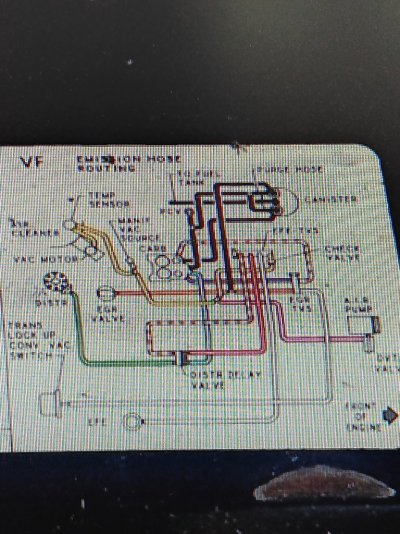
Maybe. I will check the hose routing later. The actual schematic from underhood is attached - the TVS is actually a 4 port and the only one not hooked up is the TCC as it is hooked direct to manifold vacuum ( prior tech routing & I left it as it works. )


Attachments

  • 20260206_123708.jpg
    20260206_123708.jpg
    254 KB · Views: 19
Last edited:

Chevrolado

Full Access Member
Joined
Dec 13, 2012
Posts
903
Reaction score
1,905
Location
McKinney, TX
First Name
Dave
Truck Year
1977|2006
Truck Model
K10|1500
Engine Size
5.7|5.3
I actually didnt measure it. Should have though as I recall reading conflicting information as I ordered it.. I still have my OE one though, maybe I'll measure it for the heck of it.

You must be registered for see images attach

the
Interesting.. my original cable I pulled out looks to only be about 20”
 

Old Guy Bill

Supporting Member
Supporting Member
Joined
Sep 10, 2023
Posts
981
Reaction score
2,957
Location
KY
First Name
Bill
Truck Year
1978
Truck Model
K20
Engine Size
400
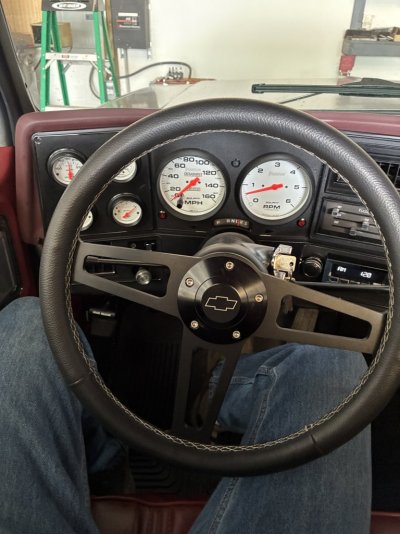
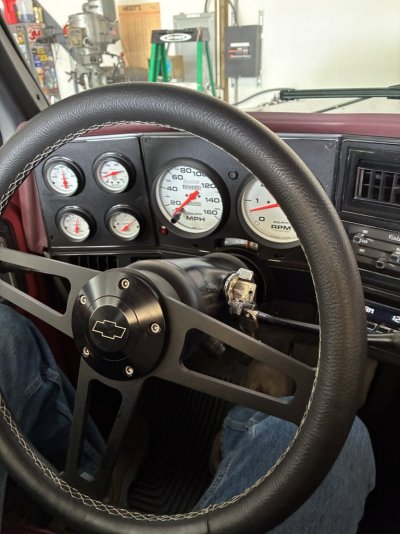
This is the final result of my dash hack.
I'm satisfied, didn't want a speedo that went that high but it's not offered.
 

Attachments

  • IMG_8257.jpeg
    IMG_8257.jpeg
    150.2 KB · Views: 32
  • IMG_8258.jpeg
    IMG_8258.jpeg
    147.7 KB · Views: 34

Bextreme04

Supporting Member
Supporting Member Army
Joined
May 13, 2019
Posts
4,826
Reaction score
6,530
Location
Oregon
First Name
Eric
Truck Year
1980
Truck Model
K25
Engine Size
350-4bbl
Maybe. I will check the hose routing later. The actual schematic from underhood is attached - the TVS is actually a 4 port and the only one not hooked up is the TCC as it is hooked direct to manifold vacuum ( prior tech routing & I left it as it works. )


How are all of them hooked up? You have a 4-port spark delay valve on it now? These is what they normally look like:
https://www.gmpartsgiant.com/parts/gm-valve-476330.html

But they are all discontinued and not made anymore. I would recommend just removing the two red and red-hashed lines from the TVS to the delay valve, plug them on the TVS, then connect the line from the distributor directly to the carb. The valve was meant to keep vacuum from getting to distributor so that the timing would be retarded when cold... purely for cold start emissions.
 

Goldie Driver

Full Access Member
Joined
Mar 19, 2018
Posts
4,374
Reaction score
7,551
Location
Houston, Texas
First Name
Britt
Truck Year
1980
Truck Model
GMC K1500 Suburban
Engine Size
350
How are all of them hooked up? You have a 4-port spark delay valve on it now? These is what they normally look like:
https://www.gmpartsgiant.com/parts/gm-valve-476330.html

But they are all discontinued and not made anymore. I would recommend just removing the two red and red-hashed lines from the TVS to the delay valve, plug them on the TVS, then connect the line from the distributor directly to the carb. The valve was meant to keep vacuum from getting to distributor so that the timing would be retarded when cold... purely for cold start emissions.
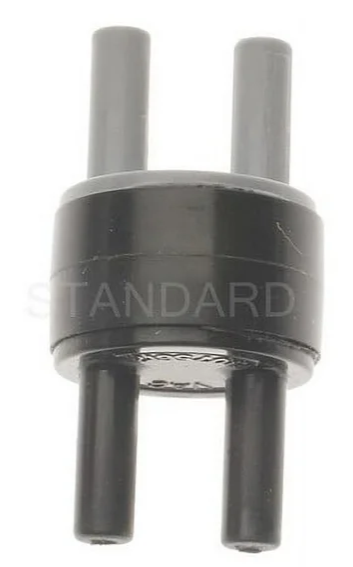
No spark delay - it is at the house, in the box with the other hoses & connectors that came off. I individually plumbed the lines using the old preformed hoses & the schematic as a guide. My valve looked pretty much like that schematic pic - round with 4 ports. ( Image now attached ) The distributor is plumbed directly to a manifold vacuum port on the carb - not thru a TVS. The 2 TVS's are operating the EFE ( works 100% correct ) & the EGR which gets vacuum as it should and the vacuum shuts off when heavy throttle is applied. The output line from the EGR TVS to the TCC is plugged since that is being powered by a separate line.

It may well be a carb issue.


:think:


Link for image : https://www.walmart.com/ip/Standard...HEVROLET-C10-1984-1986-CHEVROLET-K10/46070221
 

Attachments

  • Vacuum Valve.PNG
    Vacuum Valve.PNG
    140.4 KB · Views: 17
Last edited:

WFarm

Full Access Member
Joined
Jan 11, 2023
Posts
1,200
Reaction score
7,638
Location
Central Virginia
First Name
Paul
Truck Year
1975
Truck Model
K5 Blazer
Engine Size
454
Just about finished removing the AC components. Not a difficult job, especially with the right side inner fender removed. Now it’s time to clean stuff up, route wiring and get ready to install the new AC Delete cover.

Not completely sure at this point what wiring I need to keep so I have heat and defrost (with no top I’ll probably never need defrost lol) and what wiring I don’t need now. I don’t plan to hack the unneeded wiring and will figure out a way to wrap it and tuck it away somewhere. So if anybody here knows what wiring I need to keep please share!

I also assume I need to keep the vacuum canister for operating the vents?

So much more room to get at the engine now, especially the drivers side with that big compressor and brackets gone.

You must be registered for see images attach

You must be registered for see images attach

You must be registered for see images attach
 
Top