Ignition timing

Disclaimer: Links on this page pointing to Amazon, eBay and other sites may include affiliate code. If you click them and make a purchase, we may earn a small commission.

fnny6770

Full Access Member
Joined
May 11, 2024
Posts
153
Reaction score
82
Location
Pocatello
First Name
Paul
Truck Year
1980
Truck Model
3500 camper special
Engine Size
454
What should the timing on my 78 454 be? It's a slightly modified engine with an RV cam that's in my 1:10 dual four wheel drive with a 4-speed manual
 

fnny6770

Full Access Member
Joined
May 11, 2024
Posts
153
Reaction score
82
Location
Pocatello
First Name
Paul
Truck Year
1980
Truck Model
3500 camper special
Engine Size
454
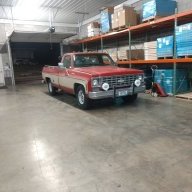
1980 GMC 1 ton dually four wheel drive
 

Bextreme04

Supporting Member
Supporting Member Army
Joined
May 13, 2019
Posts
4,876
Reaction score
6,656
Location
Oregon
First Name
Eric
Truck Year
1980
Truck Model
K25
Engine Size
350-4bbl
Factory spec is probably 4 BTC with the vacuum line pulled and plugged on the manifold or carb side depending on where it is connected to. Most people would suggest kicking that up a bit. I generally set mine by total timing and let the initial fall where it may. 34-36 Total is generally where the early BBC/SBC want to be.
 

Matt69olds

Full Access Member
Joined
Jan 8, 2018
Posts
2,850
Reaction score
4,713
Location
Central Indiana
First Name
Matt
Truck Year
81
Truck Model
GMC 1/2 ton
Engine Size
455 Olds
Give the engine what it wants, not what you think it needs.

Most engines like 34-36 degrees of mechanical advance, plus another 10-15 degrees of vacuum advance.

For now, disconnect the vacuum and concentrate on the initial and centrifugal advance. Be prepared to spend lots of time playing around to find the happy place.

Read this:


fnny6770

Full Access Member
Joined
May 11, 2024
Posts
153
Reaction score
82
Location
Pocatello
First Name
Paul
Truck Year
1980
Truck Model
3500 camper special
Engine Size
454
I have an adjustable timing light but I've never used it for total timing, what's the procedure for using it for total timing?
 

Ricko1966

Full Access Member
Joined
Apr 11, 2017
Posts
10,175
Reaction score
19,671
Location
kansas
First Name
Rick
Truck Year
1975
Truck Model
c20
Engine Size
350
I have an adjustable timing light but I've never used it for total timing, what's the procedure for using it for total timing?
Disconnect and plug the vacuum advance. Loosen the distributor hold down to snug,you can move the distributor by hand, but it won't move on its own. Set the dialback on your light to 34 degrees start the engine point the light at the balancer,rev the engine until the balancer timing mark quits moving. Twist the distributor until the tdc marks line up on the balancer and timing cover. Tighten the distributor clamp and reconnect the vacuum advance. From there you can start tweaking total,find a stretch of road as long as football field or so. Find 2 land marks a start and a finish line,move your total up and down a couple of degrees at a time,and checking your MPH at the finish line. Highest MPH with lowest Total timing is what you want. I would actually start low and go up 2 degrees at a time until MPH plateaus. Then back to the lowest setting. You don't have to check total each time adding or subtracting 2 degrees from your new base time will add or subtract 2 degrees from your total.
 
Last edited:

75gmck25

Full Access Member
Joined
Oct 13, 2016
Posts
2,786
Reaction score
3,099
Location
Northern Virginia
First Name
Bruce
Truck Year
1975
Truck Model
K25 Camper Special TH350 NP203
Engine Size
5.7
The procedure above will work fine, but it doesn’t tell you how quickly your centrifugal timing increases as you go up in rpm.

Most stock centrifugal setups add 18-20 degrees of timing as rpm rises. A stock unit may need to get to 3k rpm to hit the max, but by using a kit and swapping weights you could get it to start at 2k and reach the max by 2.5k. Depending on how well it works with your vacuum advance, this can work well to increase mid-range power without any pinging..

You also have to work around your gear ratio and normal cruising rpm. My truck has 4.10 gears, so at 70 mph I’m at about 3200 rpm and I’ve reached maximum advance (in my case that is about 34-35 degrees for base plus centrifugal). When you add in the 15 degrees from my aftermarket vacuum advance, I’m at 50-51 degrees when cruising.

This seems to work fine and I have no pinging at light throttle, but I may be right on the edge of detonation. If I used my stock vacuum advance it would have added 20 (54-55 with VA) degrees, which would probably be too much.

 

Ricko1966

Full Access Member
Joined
Apr 11, 2017
Posts
10,175
Reaction score
19,671
Location
kansas
First Name
Rick
Truck Year
1975
Truck Model
c20
Engine Size
350
The procedure above will work fine, but it doesn’t tell you how quickly your centrifugal timing increases as you go up in rpm.

Most stock centrifugal setups add 18-20 degrees of timing as rpm rises. A stock unit may need to get to 3k rpm to hit the max, but by using a kit and swapping weights you could get it to start at 2k and reach the max by 2.5k. Depending on how well it works with your vacuum advance, this can work well to increase mid-range power without any pinging..

You also have to work around your gear ratio and normal cruising rpm. My truck has 4.10 gears, so at 70 mph I’m at about 3200 rpm and I’ve reached maximum advance (in my case that is about 34-35 degrees for base plus centrifugal). When you add in the 15 degrees from my aftermarket vacuum advance, I’m at 50-51 degrees when cruising.

This seems to work fine and I have no pinging at light throttle, but I may be right on the edge of detonation. If I used my stock vacuum advance it would have added 20 (54-55 with VA) degrees, which would probably be too much.
I figured we'd let him get his feet wet first,but you're right there's more to it than just total and, ps. I believe in vacuum limiters if you need to alter vacuum advance degrees use the can for in and out HGs,use a stop for degrees.
 
Last edited:

fnny6770

Full Access Member
Joined
May 11, 2024
Posts
153
Reaction score
82
Location
Pocatello
First Name
Paul
Truck Year
1980
Truck Model
3500 camper special
Engine Size
454
Thank you for the information, my truck is supposed to have 4:10 gears in the differential, the other day I took it on the highway and I was doing 55 miles an hour the RPM was just above 3000, which seemed a little high cuz the RPMs were up there, but this truck originally came from the factory with the th400 and my brother put in a manual four speed out of his 78 3/4 ton, I imagine it's going to take a little bit of experimentations with this to get it right.
 

Ricko1966

Full Access Member
Joined
Apr 11, 2017
Posts
10,175
Reaction score
19,671
Location
kansas
First Name
Rick
Truck Year
1975
Truck Model
c20
Engine Size
350
Thank you for the information, my truck is supposed to have 4:10 gears in the differential, the other day I took it on the highway and I was doing 55 miles an hour the RPM was just above 3000, which seemed a little high cuz the RPMs were up there, but this truck originally came from the factory with the th400 and my brother put in a manual four speed out of his 78 3/4 ton, I imagine it's going to take a little bit of experimentations with this to get it right.
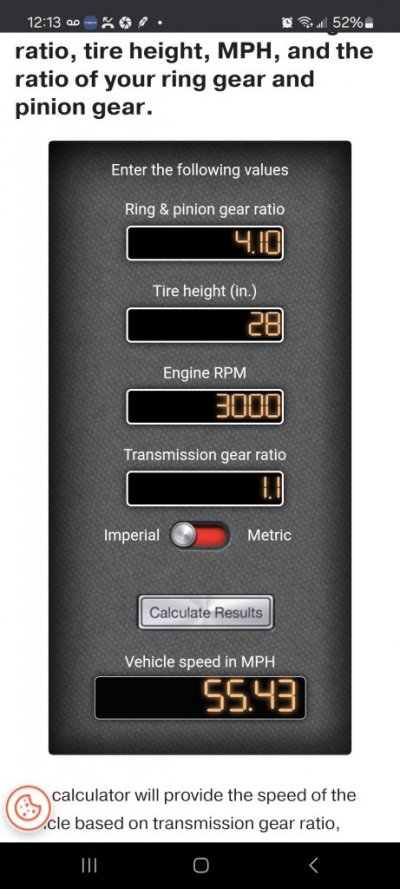
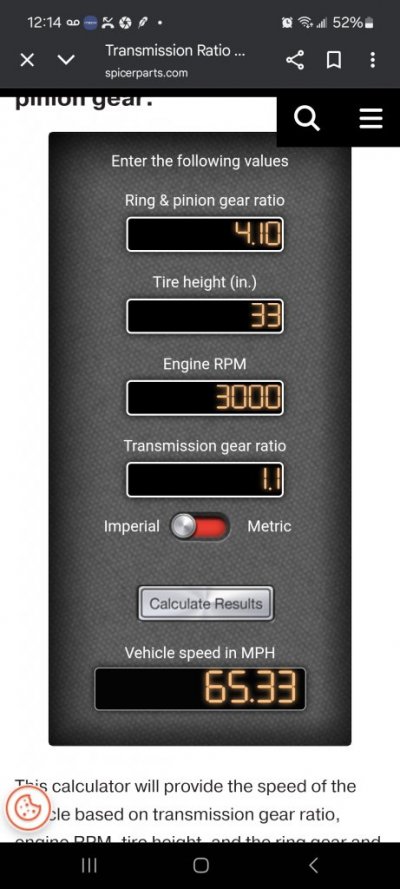
Turbo 400 and 4 speed have the same final drive ratio. 1:1. The rpms are because of the 4.10 gears. 3000 doesn't sound unreasonable for 4.10 gears. Depending on tire size .
 

Attachments

  • Screenshot_2025-11-06_121315.jpg
    Screenshot_2025-11-06_121315.jpg
    78.9 KB · Views: 34
  • Screenshot_2025-11-06_121423.jpg
    Screenshot_2025-11-06_121423.jpg
    76.6 KB · Views: 49

legopnuematic

Licensed Junk Dealer
Supporting Member
Joined
Oct 27, 2016
Posts
5,319
Reaction score
20,093
Location
MO
First Name
Spencer
Truck Year
1971, 1̶9̶7̶4, 1976, 1979,1̶9̶8̶5, 2002
Truck Model
Dart Swinger, Sierra 10, C10 Cheyenne, C10 Big Ten, Silverado 10, Ram 2500
Engine Size
225/6, 350 c.i., 350 c.i., 5.9l Cummins
With 29” tall tires (on the shorter side of things), with 4.10s at 3k is 63mph, 29” tires with 4.56 gears is 56mph at 3k.

What is your tire size?

As Rick said, both are 1:1 finals, so no difference there, the manual would be slightly lower being there is not torque converter losses that a non lockup auto has.
 

fnny6770

Full Access Member
Joined
May 11, 2024
Posts
153
Reaction score
82
Location
Pocatello
First Name
Paul
Truck Year
1980
Truck Model
3500 camper special
Engine Size
454
I don't know the size of the tires off the top of my head but they're due to be replaced so maybe some taller tires will be in order?
 

75gmck25

Full Access Member
Joined
Oct 13, 2016
Posts
2,786
Reaction score
3,099
Location
Northern Virginia
First Name
Bruce
Truck Year
1975
Truck Model
K25 Camper Special TH350 NP203
Engine Size
5.7
Using 235/85R16E tires would be one stock (about 31.5”) tire that has the load rating you need for a K35. It’s a common tire size for SRW high GVW pickups. Other tire sizes may also work, but you have to determine whether they have the load rating you need, and that they will work with a stock 6.5 inch wide wheel.

On a dually you don’t really need the E load rating on rear tires because you have four tires to take the load on the rear axle. However, it just seems easier to use the same tire on all four wheels.
 

fnny6770

Full Access Member
Joined
May 11, 2024
Posts
153
Reaction score
82
Location
Pocatello
First Name
Paul
Truck Year
1980
Truck Model
3500 camper special
Engine Size
454
I upgraded to 17-in rims, so that's the rim size of the tire I will be going with now I just need to decide what size of tire?
 

Latest posts

Forum statistics

Threads
48,666
Posts
1,074,187
Members
43,338
Latest member
jw23655
Top