Heater Motor?

Disclaimer: Links on this page pointing to Amazon, eBay and other sites may include affiliate code. If you click them and make a purchase, we may earn a small commission.

AuroraGirl

Full Access Member
Joined
Sep 8, 2019
Posts
10,710
Reaction score
8,239
Location
Northern Wisconsin
First Name
Taylor
Truck Year
1978, 1980
Truck Model
K10, K25
Engine Size
400(?), 350
You must be registered for see images attach

my 1980
I'm going to try removing the low speed feed from the resistor module. Low speed is not going to defrost a window.
(my controls broke, but you someone could still intercept that wire with a proper hvac controls still in )
 

Dejure

Full Access Member
Joined
Mar 3, 2025
Posts
477
Reaction score
925
Location
Eastern Washington
First Name
Kelly
Truck Year
1978
Truck Model
C15
Engine Size
350
Old post, but info remains info.

I posted notes I am in the process of upgrading. There is a vastly improved upon version waiting for me to polish it. It gives a lot of details about the wiring of this system:


My previous truck, about 40 years back, had the annoying heater-always-on issue. The toggle died, so I replaced it with just a rocker, doing away with the low speed circuit.

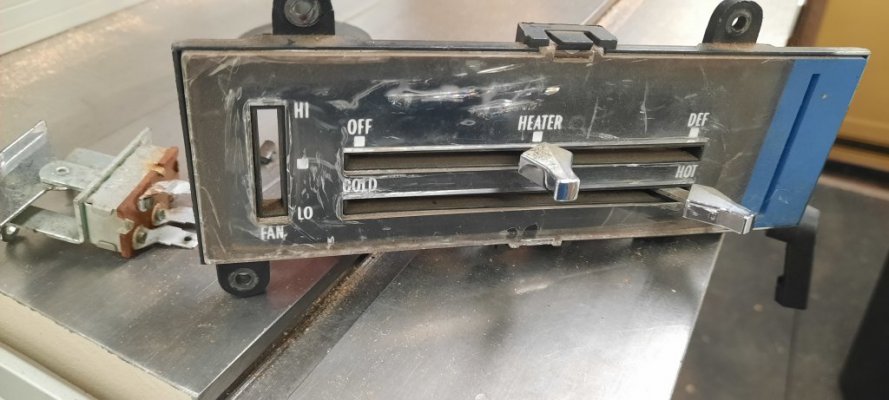
Now, all these years later, I have a 78, which had some heater issues that included a trashed looking control panel. I could have made do by removing the 3 position switch and replacing it. Hoped to find a 4 position one, but couldn't, until I found one that was part of a whole control panel replacement.

That let me leave the first spot open, to give me an off position.

Meanwhile, this system is far more simple than it first seems, and there are a lot of improvements one could do, like the 4 position switch panel swap, bypass for summer (route the water back to/through the engine) to continue circulation.
 

AuroraGirl

Full Access Member
Joined
Sep 8, 2019
Posts
10,710
Reaction score
8,239
Location
Northern Wisconsin
First Name
Taylor
Truck Year
1978, 1980
Truck Model
K10, K25
Engine Size
400(?), 350
Old post, but info remains info.

I posted notes I am in the process of upgrading. There is a vastly improved upon version waiting for me to polish it. It gives a lot of details about the wiring of this system:


My previous truck, about 40 years back, had the annoying heater-always-on issue. The toggle died, so I replaced it with just a rocker, doing away with the low speed circuit.

Now, all these years later, I have a 78, which had some heater issues that included a trashed looking control panel. I could have made do by removing the 3 position switch and replacing it. Hoped to find a 4 position one, but couldn't, until I found one that was part of a whole control panel replacement.

That let me leave the first spot open, to give me an off position.

Meanwhile, this system is far more simple than it first seems, and there are a lot of improvements one could do, like the 4 position switch panel swap, bypass for summer (route the water back to/through the engine) to continue circulation.
you dont have to do that to get an off possition, the 1982+ trucks im pretty sure have no constant on function so the electrical from that could swap im pretty sure
 

Dejure

Full Access Member
Joined
Mar 3, 2025
Posts
477
Reaction score
925
Location
Eastern Washington
First Name
Kelly
Truck Year
1978
Truck Model
C15
Engine Size
350
you dont have to do that to get an off possition, the 1982+ trucks im pretty sure have no constant on function so the electrical from that could swap im pretty sure
You'd still need to swap the 3 position switch (low always on, medium and high) to have all three speeds and an off position. Thus I replaced my horrible looking control panel with a new one from LMC Trucks, but went with the four position one intended for four speed blowers (low, medium-1, medium-2 and high (bypass the resistor).

In rainy country and the like, even that low speed can be handy, to KEEP the fog off the windows, once it's removed, without having to hear the louder fan speed.

You could add a toggle to kick the low in and out, while still using the original 3 position switch.

When I was digging for solutions, I was almost ready to opt for a stacked switch (knob type, with four positions), like I added to my home HVAC so I could swap between low, medium and high, allowing me to run more air in the summer, or just run the blower on low. They are pretty cheap and with a simple ohm meter you can dump hot in, jump it to the other positions, connect the other wires for those positions and you're off and running.

I would have preferred a 4 position rocker, but they cost as much as the entire panel did.

Then there is that finding a salvage unit would mean traveling hours to find a unit with a switch already having miles on it.
 

AuroraGirl

Full Access Member
Joined
Sep 8, 2019
Posts
10,710
Reaction score
8,239
Location
Northern Wisconsin
First Name
Taylor
Truck Year
1978, 1980
Truck Model
K10, K25
Engine Size
400(?), 350
You'd still need to swap the 3 position switch (low always on, medium and high) to have all three speeds and an off position. Thus I replaced my horrible looking control panel with a new one from LMC Trucks, but went with the four position one intended for four speed blowers (low, medium-1, medium-2 and high (bypass the resistor).

In rainy country and the like, even that low speed can be handy, to KEEP the fog off the windows, once it's removed, without having to hear the louder fan speed.

You could add a toggle to kick the low in and out, while still using the original 3 position switch.

When I was digging for solutions, I was almost ready to opt for a stacked switch (knob type, with four positions), like I added to my home HVAC so I could swap between low, medium and high, allowing me to run more air in the summer, or just run the blower on low. They are pretty cheap and with a simple ohm meter you can dump hot in, jump it to the other positions, connect the other wires for those positions and you're off and running.

I would have preferred a 4 position rocker, but they cost as much as the entire panel did.

Then there is that finding a salvage unit would mean traveling hours to find a unit with a switch already having miles on it.
I meant more like you could use aftermarket replacement for that year but 4 speed blower switches are for the Deluxe heater models, right? @bucket i feel like we have a thread on this switch and why it was used in some but not all models
And 1985 was the year i think i thought of, i think 83 still used flow-thru
 

Dejure

Full Access Member
Joined
Mar 3, 2025
Posts
477
Reaction score
925
Location
Eastern Washington
First Name
Kelly
Truck Year
1978
Truck Model
C15
Engine Size
350
The control on this web page is what I installed. It is, exactly, like the one that was in my 78, but this one has four switch positions.

Switches run around fifty, or more, other than what I talked about above, so I just went the extra twenty for a new assembly.

LMC TRUCK
Temperature Control Assy "B"
Part #: 32-0636


SIDE NOTE: The control panel in mine was all fractured. Genius former owners did something interesting. When I pulled the old one, one of the two screw mounts for the switch was broken. This photo is what it looked like.


I don't know if the B unit was for the "deluxe model," or if it was for those with air. Indication is, the four speed is for low, medium one, medium two and high.

If using the four position one, if you didn't care about the fan running on low with the engine on, one could modify the system to add the medium two function for those times high was too much (e.g., loud) and medium too low.

That could be as simple as installing a wire resistor able to handle the wattage and with a value between the ohm rating, for example, a bit less than the medium circuit.

Depending on how you went about it, it might require a different connector. If you wanted the fan off unless you put it on low, you'd have to add a switch.

Others don't care about low and just disconnect it at the resistor.

Anyway, it could be done and still look nice.

When I swapped the dead switch on my 69, I cut and filed the hole the stock switch was in and now one knew anything had been done. However, all it gave me was medium and high.
 

Attachments

  • Control Before-2.jpg
    Control Before-2.jpg
    86.3 KB · Views: 41
Last edited:

AuroraGirl

Full Access Member
Joined
Sep 8, 2019
Posts
10,710
Reaction score
8,239
Location
Northern Wisconsin
First Name
Taylor
Truck Year
1978, 1980
Truck Model
K10, K25
Engine Size
400(?), 350
The control on this web page is what I installed. It is, exactly, like the one that was in my 78, but this one has four switch positions.

Switches run around fifty, or more, other than what I talked about above, so I just went the extra twenty for a new assembly.

LMC TRUCK
Temperature Control Assy "B"
Part #: 32-0636


SIDE NOTE: The control panel in mine was all fractured. Genius former owners did something interesting. When I pulled the old one, one of the two screw mounts for the switch was broken. This photo is what it looked like.


I don't know if the B unit was for the "deluxe model," or if it was for those with air. Indication is, the four speed is for low, medium one, medium two and high.

If using the four position one, if you didn't care about the fan running on low with the engine on, one could modify the system to add the medium two function for those times high was too much (e.g., loud) and medium too low.

That could be as simple as installing a wire resistor able to handle the wattage and with a value between the ohm rating, for example, a bit less than the medium circuit.

Depending on how you went about it, it might require a different connector. If you wanted the fan off unless you put it on low, you'd have to add a switch.

Others don't care about low and just disconnect it at the resistor.

Anyway, it could be done and still look nice.

When I swapped the dead switch on my 69, I cut and filed the hole the stock switch was in and now one knew anything had been done. However, all it gave me was medium and high.
You must be registered for see images attach
The one you ordered is, i think, the model you would use for a DELUXE HEATER (RPO option)
Those trucks had a, best I can tell, better heater core, the 4th speed switch, no AC, and came with cab insulation, possibly a cooler tube that ran to the blower motor but unsure, and stuff. so youll like this I think!

I like the idea of a separate switch for the always-on feature , are you going to do that? obviously I did that to my truck but because its a plow truck and im lazy I just never replaced the control assembly LOL
 

Dejure

Full Access Member
Joined
Mar 3, 2025
Posts
477
Reaction score
925
Location
Eastern Washington
First Name
Kelly
Truck Year
1978
Truck Model
C15
Engine Size
350
That first of 4 positions, being the off position for the fan in my modified system, is, exactly, why I went with this switch instead of the 3 position ones it replaced.

Instead of leaving the connector wires where they were, I re-positioned them so position one had nothing on it. Position 2 became low, 3 became medium and 4 became high.

That way, no extra switch was needed.

It remains, as you indicate, another switch would be needed for rigs with the 2 medium speeds [that, also, must have a completely different resistor, to drop different amounts of voltage going into the blower for the 2 medium speeds] to gain an off position.
 

AuroraGirl

Full Access Member
Joined
Sep 8, 2019
Posts
10,710
Reaction score
8,239
Location
Northern Wisconsin
First Name
Taylor
Truck Year
1978, 1980
Truck Model
K10, K25
Engine Size
400(?), 350
That first of 4 positions, being the off position for the fan in my modified system, is, exactly, why I went with this switch instead of the 3 position ones it replaced.

Instead of leaving the connector wires where they were, I re-positioned them so position one had nothing on it. Position 2 became low, 3 became medium and 4 became high.

That way, no extra switch was needed.

It remains, as you indicate, another switch would be needed for rigs with the 2 medium speeds [that, also, must have a completely different resistor, to drop different amounts of voltage going into the blower for the 2 medium speeds] to gain an off position.
Oh i see now!
With heat only and non-direct vents , i cant see medium 1 and medium 2 being compelling enough to have the 4 speeds vs having an off position in your pre 85 or whatever truck. I support it. Just dont have exhaust leaks lol!
 

Dejure

Full Access Member
Joined
Mar 3, 2025
Posts
477
Reaction score
925
Location
Eastern Washington
First Name
Kelly
Truck Year
1978
Truck Model
C15
Engine Size
350
Interestingly, we survived exhaust leaks without government agents' help.

My 48 Merc coup, back about 67, had a bad exhaust leak. The plus side was, the floors were way rusted out and the heat kept you warm in the 20 below and worse of North Cental Washington (Brewster, Wash). The missing driver's window kept fresh air flowing through the rigs, so it all worked out.
 

Attachments

  • z-Laugh-2.jpg
    z-Laugh-2.jpg
    9.9 KB · Views: 25

AuroraGirl

Full Access Member
Joined
Sep 8, 2019
Posts
10,710
Reaction score
8,239
Location
Northern Wisconsin
First Name
Taylor
Truck Year
1978, 1980
Truck Model
K10, K25
Engine Size
400(?), 350
Interestingly, we survived exhaust leaks without government agents' help.

My 48 Merc coup, back about 67, had a bad exhaust leak. The plus side was, the floors were way rusted out and the heat kept you warm in the 20 below and worse of North Cental Washington (Brewster, Wash). The missing driver's window kept fresh air flowing through the rigs, so it all worked out.
The exhaust leak thing was about carbon in the cabin, not government regs. lol.

Thats one of the purported reasons gm went to flow-through ventilation in the 60s with the cars especially, they werent well sealed and the intake of air from the cowl area, hidden wipers and imperfect cowl sealing and the flow of air around a car generally was allowing cabins to fill with carbon dioxide from the exhaust, so having an always-on fan would force an exchange of air even at low speeds or stopped , that likely would keep it from dangerous levels.
Im not sure if this IS the reason the models across the board went to it or not, clearly by the mid 80s gm was confident it wasnt a problem anymore or they wouldnt have stopped doing it.
xc_hide_links_from_guests_guests_error_hide_media
This tv ad says more about cigarette smoke not pluming up the interior with the windows closed, but that could be incidental or primary drive (people smoked a lot in 1971), and cigarettes from what I could tell tended to be more smoky but thats just my perception seeing old films and such
 

Dejure

Full Access Member
Joined
Mar 3, 2025
Posts
477
Reaction score
925
Location
Eastern Washington
First Name
Kelly
Truck Year
1978
Truck Model
C15
Engine Size
350
Who do you think came up with the "solution"? It was not Detroit, which only acted when there was a real danger to their financial position.

SIDE NOTE: The last few decades of my life, before I retired, were spent dealing with public agents, who imposed their agency regulations on We The People.

We The People, generally, labor under the erroneous belief our government (incapable of good or ill, absent acts in its name done by agents) know what they are doing and offer sound solutions that actually address real issues we, otherwise, suffer.

QUESTION: "Did Detroit always impose cabin ventilation after the 60's"

ANSWER: "Automakers began adopting positive crankcase ventilation voluntarily as a pollution control measure, but resisted making closed systems mandatory until regulators in California and New York enforced stricter rules.
  • Federal emission standards via the Clean Air Act Amendments of 1970 further strengthened requirements, but these focused on emissions rather than specific cabin ventilation designs.

  • Regulations on passenger comfort and cabin ventilation, such as requirements for outside air inlets, were incrementally adopted through the 1970s and later, often as part of air conditioning and heating system improvements.
Detroit Approach
  • Iconic Detroit features like "Breezeway Ventilation," found on select Mercury models, were innovative but did not become universal; features like power vent windows and flow-through ventilation systems appeared inconsistently across brands and models.
  • By the late 1970s and early 1980s, most new cars included some form of outside air intake and improved interior air movement, partially as a result of regulatory pressure, consumer demand for comfort, and technical advancements in HVAC systems.
  • Detroit automakers often delayed full adoption of new ventilation standards, seeking competitive advantage or cost savings when possible."
  • . . . . Why.....the actual facts?
 

AuroraGirl

Full Access Member
Joined
Sep 8, 2019
Posts
10,710
Reaction score
8,239
Location
Northern Wisconsin
First Name
Taylor
Truck Year
1978, 1980
Truck Model
K10, K25
Engine Size
400(?), 350
Who do you think came up with the "solution"? It was not Detroit, which only acted when there was a real danger to their financial position.

SIDE NOTE: The last few decades of my life, before I retired, were spent dealing with public agents, who imposed their agency regulations on We The People.

We The People, generally, labor under the erroneous belief our government (incapable of good or ill, absent acts in its name done by agents) know what they are doing and offer sound solutions that actually address real issues we, otherwise, suffer.

QUESTION: "Did Detroit always impose cabin ventilation after the 60's"

ANSWER: "Automakers began adopting positive crankcase ventilation voluntarily as a pollution control measure, but resisted making closed systems mandatory until regulators in California and New York enforced stricter rules.
  • Federal emission standards via the Clean Air Act Amendments of 1970 further strengthened requirements, but these focused on emissions rather than specific cabin ventilation designs.

  • Regulations on passenger comfort and cabin ventilation, such as requirements for outside air inlets, were incrementally adopted through the 1970s and later, often as part of air conditioning and heating system improvements.
Detroit Approach
  • Iconic Detroit features like "Breezeway Ventilation," found on select Mercury models, were innovative but did not become universal; features like power vent windows and flow-through ventilation systems appeared inconsistently across brands and models.
  • By the late 1970s and early 1980s, most new cars included some form of outside air intake and improved interior air movement, partially as a result of regulatory pressure, consumer demand for comfort, and technical advancements in HVAC systems.
  • Detroit automakers often delayed full adoption of new ventilation standards, seeking competitive advantage or cost savings when possible."
  • . . . . Why.....the actual facts?
oh
Idk i guess.

SOmething to note is after a certain point, the government is barely the bad guy in an arena of regulatory capture and special interests. GM has benefited greatly in this regard
 

Dejure

Full Access Member
Joined
Mar 3, 2025
Posts
477
Reaction score
925
Location
Eastern Washington
First Name
Kelly
Truck Year
1978
Truck Model
C15
Engine Size
350
Meanwhile, ignorance and stupidity yet abound. Houses and such are safer, but a one-size-fits-all is not the ideal solution.

For example:

(1) Public agents not competent to make such decisions wanted to tax us just for having pickups and trucks, all under the guise of saving the planet.

Meanwhile, there are many of us out there more interested in dependability and mileage than hot-rodding. We took lessons from the big trucks - more gears with lower gears, to allow relatively small engines to move big loads, but still get good mileage when opportunity prevailed.

Too, to the end of having an efficient rig, we did not add all the things public agents wanted, but that resulted in the engines tuned in such a way their mileage and performance stunk, compared to what a given engine could have done.

My little 250 inline 6 with 6 gears in the 3spd tranny (from a 62 wagon with an overdrive) was able to pull the steep slope of the mountain pass pulling my loaded camp trailer in 3rd under.

At that time, Ford had a 460, which was so detuned for emissions it, with the Detroit choices for transmissions (it was just hauling a cab-over camper), could not keep up with my loaded 6 cylinder truck and trailer on a steep climb, and which did regular 22mpg on the open road.

Then there are the complications that make it impossible to do your own maintenance (plug changes, troubleshooting electronics, etc.).

On these later cars and trucks, relays are more about minor cost savings on builds than about efficiency or dependability. Many relays are used to save wire, rather than to take a load off a switch.

(2) Septic systems. Helped a fellow with legal problems, because he used a common, proven, Canadian version of a septic system, rather than one of the locally approved ones. It was a short battle, but a battle nonetheless, before the county wrote him to tell him to move back on his property and, please, quit coming after them [for their many blunders and acts done contrary to law].

(3) Electrical. Codes only require minimums. This has resulted in folks with shops and who relied on licensed electricians to tell them what they needed wiring outlets for 14 gauge wire, limiting what could be put on the circuit, compared to standard 12 gauge wire. In the end, the finished shop had to have conduit added so the owner could use equipment.

Even on that, it's frustratingly comical to consider conversations and claims about electrical supplies. In the end, it's ALL about heat. So just saying the panel can handle, for example, 200 amps is VERY misleading.

Aside the fact 240 circuits eat 2 slots, I could run two overhead heaters that eat 30 amps, my 2 big dust collectors that, each, eat 15 amps, one of the bandsaws (also 15 amps) and the cabinet saw (10) amps , toss in a battery charger, a weed eater, Christmas lights, radio, a freezer and a freeze dryer. . . .

(3) In the end and when talking about government, it needs to be remembered, we are talking about people. Many of whom graduated at the bottom of their classes and/or who had to take tests more than once to pass (e.g., I knew a guy who took the Mensa Society test, didn't make it, so went home and studied, took it again and passed, so, with tongue way in cheek, was able to claim he was, now, a genius.

(4) Law. The U.S. Supreme Court just put a certain crowd into a tizzy by overruling itself. That is, rightfully, recognizing it erred when it presumed to have authority nowhere granted it.

This is not to say all agents do is wrong, but it is to say there is very good reason we have not just one, but, instead, have fifty-one constitutions. That reason is, agents are not always our friends. The fact which is borne out in simple review of the thousands of case files kept by our courts, and in which agents were declared incompetent, or corrupt for all the same reasons the common man is also declared those things.

 

Forum statistics

Threads
48,419
Posts
1,067,008
Members
42,806
Latest member
that_orange_c10
Top