Part Choice-Brake System

Disclaimer: Links on this page pointing to Amazon, eBay and other sites may include affiliate code. If you click them and make a purchase, we may earn a small commission.

Scruffy49

Full Access Member
Law Enforcement Navy
Joined
Feb 28, 2025
Posts
418
Reaction score
589
Location
Rosemark TN
First Name
Jeff
Truck Year
1985
Truck Model
C10 swb
Engine Size
4.3L
The round white plastic piece at the booster end of the hose is the valve. Follow the hose back from there and you'll see a black canister with a metal ring around it, thats the filter
Oh, I’ve seen it… Ralph is nearly stone stock, right down to the literally crumbling cast iron Qjet 85/86 -ONLY- 4.3L V6 intake manifold…

Can’t wait to 350 swap him, soooo much easier to find parts…
 

Dejure

Full Access Member
Joined
Mar 3, 2025
Posts
477
Reaction score
924
Location
Eastern Washington
First Name
Kelly
Truck Year
1978
Truck Model
C15
Engine Size
350
School is still out, regarding the filters between the intake manifold and the power steering booster cans (said by someone who doesn't know anatomy from a hole in the ground, regarding these matters).

Searches indicate these are both filters and check valves. Though some of the information given is a head scratcher.

For example:

1.0 Since the hose runs between the pump and the intake manifold, we are talking about vacuum on the can, with the engine running.

1.1 It's indicated the whole purpose of the connection between the manifold and the can is, to boost power brake function by way of engine vacuum.

1.2 There is nothing passing through the hose but air from the power steering can, as a vacuum is applied.

1.3 Based on "1.2," above, there is nothing coming out of the can to be filtered (we hope?).

1.4 If the manifold puts a vacuum on the can [to assist function], shutting off the engine might leave a vacuum on it for a short while, when the engine is turned off, and until it bleeds off. This could case a reverse flow of air from the manifold, and which could be contaminated with gas fumes, and oil vapors getting past tired rings.

1.5 IF these incorporated a check valve, the aforementioned issues would be minimal.

1.6 It's indicated the filtering function of these is, to absorb gas vapors that could make it back to the can.

1.7 It's indicated these are directional (have an arrow showing which side goes to the can and which goes to the intake manifold), suggesting there is a one way/check valve to only allow air to flow one way.

1.8 Noting suggests it matters if the filter and/or check valve is in the vertical or horizontal position.

1.9 The above would suggest these last forever and a day, since they, generally, don't have to do much actual filtering.

 

DoubleDingo

Full Access Member
Joined
Jul 3, 2012
Posts
13,898
Reaction score
23,747
Location
Right where I am
First Name
Bagoomba
Truck Year
1981
Truck Model
81-C20 Silverado Camper Special-TH400-4.10s
Engine Size
Carb'ed Vortec 350
I thought that was the 1 way valve… Factory issued in Ralph, so I guess 41 years is beyond its rated service life…
Same here. Wondered why it needed two check valves on that vacuum line. Now I know I need to replace it, pretty sure it's a factory unit.
 

Terlingueno

Fictional Western Sage
Joined
Dec 29, 2020
Posts
443
Reaction score
1,579
Location
Far West Texas
First Name
Skeeter
Truck Year
1985
Truck Model
K20 Suburban-SM465
Engine Size
350
Searches indicate these are both filters and check valves. Though some of the information given is a head scratcher.

For example:

1.0 Since the hose runs between the pump and the intake manifold, we are talking about vacuum on the can, with the engine running.

1.1 It's indicated the whole purpose of the connection between the manifold and the can is, to boost power brake function by way of engine vacuum.

1.2 There is nothing passing through the hose but air from the power steering can, as a vacuum is applied.

1.3 Based on "1.2," above, there is nothing coming out of the can to be filtered (we hope?).

1.4 If the manifold puts a vacuum on the can [to assist function], shutting off the engine might leave a vacuum on it for a short while, when the engine is turned off, and until it bleeds off. This could case a reverse flow of air from the manifold, and which could be contaminated with gas fumes, and oil vapors getting past tired rings.

1.5 IF these incorporated a check valve, the aforementioned issues would be minimal.

1.6 It's indicated the filtering function of these is, to absorb gas vapors that could make it back to the can.

1.7 It's indicated these are directional (have an arrow showing which side goes to the can and which goes to the intake manifold), suggesting there is a one way/check valve to only allow air to flow one way.

1.8 Noting suggests it matters if the filter and/or check valve is in the vertical or horizontal position.

1.9 The above would suggest these last forever and a day, since they, generally, don't have to do much actual filtering.

Well...

1.2 Power steering pump?

1.3 Yes, since power brake system is not connected to power steering pump

1.5 Stated by the factory shop manual (1985 C/K 5.7L), it is a filter only. The check valve is on the front face of the booster body

1.7 There is no indication in the aforementioned factory shop manual that the filter is directional. Nor are there any arrows on the filter itself indicating a direction

1.8 The illustration in the factory shop manual shows the filter in the vertical position, with the 90 degree elbow pointing to the booster check valve. Also stated that the check valve nipple should be positioned 'from vertical' and the illustration shows the check valve nipple at 90 degrees from vertical toward the filter
 

Dejure

Full Access Member
Joined
Mar 3, 2025
Posts
477
Reaction score
924
Location
Eastern Washington
First Name
Kelly
Truck Year
1978
Truck Model
C15
Engine Size
350
Hmmm. On that 1.5 thing. check valves are dirt simple.

I made one, as an experiment, using a 1" long, 3/4" nipple, two caps, a spring and a silicone ball. I ground the inside of one cap, drilled holes in both. . . . Not much to fail. As such, if an integral part of the can, it should last that forty or so years our rigs have come to know.

On the 1.7 thing, guess it would depend. Even many filters (gas, furnace filters, etc.) want us to install a certain way because of the way reinforcements are installed, to keep the filter media from miss-forming.

Then there's 1.8. Is it just that the filter was installed because if worked for them? Just as mufflers were installed a certain way, fuel filters, air filters and so on.

Schools still out, but if the replacements sold and that mount on a floppy hoses don't carry any asks with regard to horizontal vs vertical, it may not be important.

UNLESS the filters actually have build up in the interiors and, aside regularly driving up and down 45-degree angle hills, need to be able to work as reservoirs for storing filtered junk, until replaced.
 

Steelbuddha

Full Access Member
Firefighter
Joined
Mar 16, 2024
Posts
132
Reaction score
200
Location
Central North Carolina
First Name
Jonathan
Truck Year
1984
Truck Model
K20 (dump bed)
Engine Size
350
It would seem I am still on something close to the original filter. Changing it every 42 years isn't too bad.
 

Fat 454

Full Access Member
Joined
Jul 24, 2012
Posts
382
Reaction score
605
Location
Australia
First Name
Andy
Truck Year
1973
Truck Model
C20 Suburban
Engine Size
454
You must be registered for see images attach


OOH nice ! - is that factory original willow green on your rig? Any chance of a paint code, as that is what I'm wanting to paint mine. Cheers.
 

Terlingueno

Fictional Western Sage
Joined
Dec 29, 2020
Posts
443
Reaction score
1,579
Location
Far West Texas
First Name
Skeeter
Truck Year
1985
Truck Model
K20 Suburban-SM465
Engine Size
350
You must be registered for see images attach


OOH nice ! - is that factory original willow green on your rig? Any chance of a paint code, as that is what I'm wanting to paint mine. Cheers.
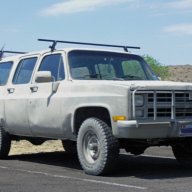
The original paint color is United States Forest Service green. On the glovebox RPO tag it says 'Special Paints' WE7941. I painted the exterior with Krylon Flat Sand.
 
Last edited:

Fat 454

Full Access Member
Joined
Jul 24, 2012
Posts
382
Reaction score
605
Location
Australia
First Name
Andy
Truck Year
1973
Truck Model
C20 Suburban
Engine Size
454
Cool - even better - I had wanted a forest service looking truck. I'll see if the local shop can match that code ( do you know if there is a paint brand associated with the code ? ) - Cheers

Something like this ..

You must be registered for see images attach
 

Terlingueno

Fictional Western Sage
Joined
Dec 29, 2020
Posts
443
Reaction score
1,579
Location
Far West Texas
First Name
Skeeter
Truck Year
1985
Truck Model
K20 Suburban-SM465
Engine Size
350
Cool - even better - I had wanted a forest service looking truck. I'll see if the local shop can match that code ( do you know if there is a paint brand associated with the code ? ) - Cheers

Something like this ..

You must be registered for see images attach
Yeah, except the top on mine is green like the rest of the truck. I didn't choose it for the color, I chose it because of the SM465 4 speed, 4.10 gears, 4 wheel drive, 350 engine, 40 gallon gas tank, plus it only had 70,465 miles on it and the price was $5000 when I signed the papers in 1994.
 

Forum statistics

Threads
48,401
Posts
1,066,547
Members
42,778
Latest member
Skippy
Top