Tire pressure

Disclaimer: Links on this page pointing to Amazon, eBay and other sites may include affiliate code. If you click them and make a purchase, we may earn a small commission.

FireGuy8

Junior Member
Joined
Oct 8, 2025
Posts
18
Reaction score
63
Location
Bayou, La
First Name
Dale
Truck Year
1983
Truck Model
C10
Engine Size
350
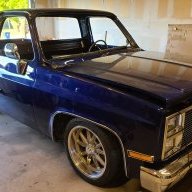
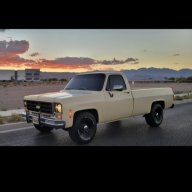
Alrighty. here I go. I`ve got a question about a good air pressure to run in the 20`s that I have on the 1983 C10. size-- 275/40R20`s rear, 245/45R20`s on the front. I`ve been running 35psi but they seem a little soft when I hit a bump, it`s Louisianna the roads suck. My question is would a little increase in the psi help stiffen up the sidewalls to ease the impact. I`ve owned many tire/wheel combo`s but I`m new to the low profile tire/wheel combination on the truck. Any thoughts?? See pic of the truck. Thanks Dale
You must be registered for see images attach
 

Scott91370

Full Access Member
Joined
Apr 2, 2018
Posts
1,147
Reaction score
1,289
Location
Burleson, Tx
First Name
Scott
Truck Year
1985
Truck Model
Sierra1500
Engine Size
350
More air will increase stiffness. You can have too much though.

I'd go up to 37 and see if it helps. You can also get some sidewalk chalk and color the tread of the tires then pull it forward or backwards to see if the tread is still touching the ground evenly.
 

Grit dog

Full Access Member
Joined
May 18, 2020
Posts
9,429
Reaction score
17,285
Location
The Right side of Washington
First Name
Todd
Truck Year
1986, 1977
Truck Model
K20, C10
Engine Size
454, 350
Tire pressure is always a tradeoff.
It helps to have a baseline. If you can figure your axle curb weights it helps. But knowing that truck is probably about 4500lbs full of gas and empty bed, you’ve got around 3k bit less maybe on the front axle and around 1500, bit more, on the rear.
If you look up a load/pressure chart for your tire sizes, you’ll see what the minimum safe pressure is for the weight.
For the fronts, you’ll see 32-35psi is about the min. Rear will be good for about 3klbs with 25psi.
Now to find the balance. I prefer to run on the lower end for ride quality and using some tire flex to soften hard bumps.
I’m running the same size combo on my C10 and believe I’m about 35F and 25R. 35psi in them big 275s is too much imo for empty daily driving. They’re basically rock hard at that pressure with no significant load in the bed. They do not feel soft.
Your fronts might. Try raising front to 40psi and lowering the rear to about 25 and see if you like it. That’s not excessive.
Like a few days ago, my son took his truck for an oil change. He’s not able to do his own where he lives (or he would…dammit…lol).
Has a Ram 1500 that curiously came equipped with E load tires and door stickers that call for 65psi or some ridiculous pressure. Like a heavy half rating or something.
He’s running 285s in place of the OE 245s and they’re LR E tires so heavier stiffer sidewalls than needed and bigger obviously.
Oil jockey wants to put his tires to 65 psi at all corners…on a half ton with bigger tires, that hauls nothing but ass, going into winter in Montana….
He had to explain to the feller that was way too much air and please go 35F, 30R….. guy was a little perplexed.

 

Grit dog

Full Access Member
Joined
May 18, 2020
Posts
9,429
Reaction score
17,285
Location
The Right side of Washington
First Name
Todd
Truck Year
1986, 1977
Truck Model
K20, C10
Engine Size
454, 350
Or my 3/4 ton K20 on 35s and Ram diesel on 37s. Those tires are way overkill for the weight of the trucks.
The K20 is 25-30psi F and 20-25psi R. The Ram 35-40psi F and 25psi R, empty. I had the rear tires on the Ram aired up to about 45psi brigade I just pulled a heavy tongue weight trailer. It rode like the tires were made of concrete with only 500lbs in the bed. Dropped them back to like 27psi last night. Huge difference in ride quality.
And remember, tire pressure changes just under 1psi per 10deg F temp change. And every 1000’ altitude changes pressure about 0.5 psi. > as alt increases.
 

CalSgt

Full Access Member
Joined
Oct 3, 2021
Posts
2,253
Reaction score
5,411
Location
CA
First Name
Casey
Truck Year
1980
Truck Model
Chevy K-10 Custom Deluxe
Engine Size
350
Tire pressure is always a tradeoff.
It helps to have a baseline. If you can figure your axle curb weights it helps. But knowing that truck is probably about 4500lbs full of gas and empty bed, you’ve got around 3k bit less maybe on the front axle and around 1500, bit more, on the rear.
If you look up a load/pressure chart for your tire sizes, you’ll see what the minimum safe pressure is for the weight.
For the fronts, you’ll see 32-35psi is about the min. Rear will be good for about 3klbs with 25psi.
Now to find the balance. I prefer to run on the lower end for ride quality and using some tire flex to soften hard bumps.
I’m running the same size combo on my C10 and believe I’m about 35F and 25R. 35psi in them big 275s is too much imo for empty daily driving. They’re basically rock hard at that pressure with no significant load in the bed. They do not feel soft.
Your fronts might. Try raising front to 40psi and lowering the rear to about 25 and see if you like it. That’s not excessive.
Like a few days ago, my son took his truck for an oil change. He’s not able to do his own where he lives (or he would…dammit…lol).
Has a Ram 1500 that curiously came equipped with E load tires and door stickers that call for 65psi or some ridiculous pressure. Like a heavy half rating or something.
He’s running 285s in place of the OE 245s and they’re LR E tires so heavier stiffer sidewalls than needed and bigger obviously.
Oil jockey wants to put his tires to 65 psi at all corners…on a half ton with bigger tires, that hauls nothing but ass, going into winter in Montana….
He had to explain to the feller that was way too much air and please go 35F, 30R….. guy was a little perplexed.
^^^ Good explanation


The Mopar brands (all brands actually) boost the tire pressure to the max safe number on the door jambs anymore... Those few extra PSI reduce fuel consumption by some tiny percentage but when calculated over the entire number of vehicles produced each year they are able to claim reduced emissions and increased MPG federally. Recommended air pressure in my Jeep was like 48 PSI IIRC...
 

Grit dog

Full Access Member
Joined
May 18, 2020
Posts
9,429
Reaction score
17,285
Location
The Right side of Washington
First Name
Todd
Truck Year
1986, 1977
Truck Model
K20, C10
Engine Size
454, 350
It’s not just Mopar and most every 1/2 ton truck and smaller (SUVs Jeeps, cars) have reasonable door placard inflation recommendations.
My boy’s 2017 Ram1500 is a weird exception and the only one I’ve physically seen come off the assembly line with the ridiculously high pressures (also programmed in the TPMS, sets off the tire idiot light at a very high pressure like 50 or 55psi).
His truck doesn’t even remotely make sense. It doesn’t have the designed or real world payload to even make use of more than a small fraction of the tire pressure recommendation.

3/4 tons are the worst as they have the full blown monitoring system with low pressure thresholds somewhere around the rather large payload/gvw weights. Literally close to double or more than double of what’s needed to drive it down the road safely.
1 tons only get an information system so less to deal with. Was looking at the new Ram 3500s and supposedly you can go into the Evic and lower the low pressure threshold down as low as 15psi.
I used to go get any new 3/4 ton (company truck) reprogrammed at the dealer. About 10 years ago, some regulations tightened up and couldn’t get dealers to do that anymore. Idk about now, maybe it’s changed?
 

FireGuy8

Junior Member
Joined
Oct 8, 2025
Posts
18
Reaction score
63
Location
Bayou, La
First Name
Dale
Truck Year
1983
Truck Model
C10
Engine Size
350
Thanks all! I was reading on the Nitto site the specs. I`m going to apply some of the knowledge here and a few other suggestions from a friend who manages a tire store. Long time old school friend who`s very knowledgeable and a hot rodder. Actually is building an early 60`s era Ford truck that the bed/cab are combined as one from Ford. Putting a built LS 6.0/4L80 combo as his drivetrain. Thanks again. Dale
 

89GMCJimmy

Full Access Member
Joined
Mar 5, 2019
Posts
116
Reaction score
77
Location
90245
First Name
ivan
Truck Year
1989
Truck Model
Jimmy
Engine Size
350
Do as scott suggested:
  1. Apply Chalk: Draw a thick line of chalk across the entire width of the tread on all four tires.
  2. Drive: Drive the vehicle straight about 100 feet at a slow, steady speed. Avoid turning
  3. Inspect the Wear Pattern:
    • Even wear: The chalk line is worn away evenly across the entire tread surface. This indicates the tire is making full contact with the road, and the pressure is correct.
    • Center wear: The chalk is worn away only in the middle of the tread. The tire is overinflated, causing the center to bulge and the edges to lift off the ground. Release some air pressure.
    • Edge wear: The chalk is worn away only on the outer edges (shoulders) of the tire. The tire is underinflated, causing the edges to flatten out and the center to lift. Add more air pressure.
  4. Repeat: Reapply the chalk, drive, and inspect again. Repeat this process until you achieve an even wear pattern across the entire tread.
  5. Record PSI: Once the wear pattern is even, use a quality tire pressure gauge to note the optimal PSI for your front and rear tires. These pressures may be different.

Every tire has different Max infl LT much higher stiffer etc than P rated
 

Grit dog

Full Access Member
Joined
May 18, 2020
Posts
9,429
Reaction score
17,285
Location
The Right side of Washington
First Name
Todd
Truck Year
1986, 1977
Truck Model
K20, C10
Engine Size
454, 350
In my experience, from a long time ago, chalk test is really only suitable for gross pressure determinations or deciding how well a fat tire on a skinny rim will do or maybe gross alignment issue diagnosis.
Since the internet was invented, it’s just too easy to look up the pressure for your tire size and load and go from there. Haven’t chalked a tire in 30 years.
 

89GMCJimmy

Full Access Member
Joined
Mar 5, 2019
Posts
116
Reaction score
77
Location
90245
First Name
ivan
Truck Year
1989
Truck Model
Jimmy
Engine Size
350
So an E rated 10 ply tire and P rated tire on the same vehicle would you put the same air pressure?
would the weight of vehicle and tire construction not effect psi? I have found that most stickers from the manufacturer are always to low. The lower pressures always feel soft and boaty as if no sway bar.
I am running 38psi fronts 34psi rear and the tires wear evenly and have full contact patch on 2012 Tahoe no rear seats unloaded. BFG KO2
 

Hunter79764

Full Access Member
Joined
Sep 1, 2021
Posts
529
Reaction score
930
Location
Grand Prairie, TX
First Name
Shawn
Truck Year
1987
Truck Model
Suburban V20
Engine Size
350
P and E rated would be close to the same pressure for the same load, but the E rated will allow more air pressure to carry more load. LT/E tires do need a little more pressure than P tires, but usually not a huge factor, maybe 5 psi more, give or take. This chart is for different load rated tires, but it shows the idea pretty well.
You must be registered for see images attach


The link below is a good read if you want to really dig in, but the short version is to figure out your axle weights, split them in 2, and use the tables for the tire size. And you will probably end up right around the 35/25 psi Grit Dog recommended above.


Goldilocks77

Supporting Member
Supporting Member
Joined
Jun 23, 2024
Posts
18
Reaction score
16
Location
Las Vegas
First Name
Shawn
Truck Year
1977
Truck Model
C20
Engine Size
350
How much do different tire styles and manufacturers affect those numbers? I’ve been running BFGoodrich All Terrain T/As for years on my C20. LT265/75R16. Damn things call for 80psi cold. I’ve had em on there for 7 years and always ran between 45-50psi and they’ve worn and felt great. They’re due to be replaced but from what I’m reading on this thread, I’ve been running them to full. Thoughts?
 

backwoodsman

Full Access Member
Joined
Feb 22, 2023
Posts
55
Reaction score
73
Location
Idaho
First Name
Dan
Truck Year
1983
Truck Model
GMC Suburban K1500
Engine Size
6.2L diesel
My question is would a little increase in the psi help stiffen up the sidewalls to ease the impact.

Unless I'm misunderstanding you, it seems like you may be thinking backwards. More pressure will make a rougher ride and more impact on bumps. If you want to soften the ride, you want less pressure, but the problem with that is those low-profile tires. When there's that little between the wheel and the ground, you have to keep the pressure up because of the greatly increased chance of breaking a rim should you hit a pothole or curb a little too hard.

Tires are designed to run with a certain contact patch, which you get when the tire is at the maximum load and maximum pressure printed on the sidewall. At less load, to get the correct contact patch, run proportionally less pressure, i.e. if the tire is carrying 75% of its maximum load, run it at 75% of its maximum pressure. You can tweak that a little, a bit more pressure for more MPG on the highway or a bit less for a better ride at low speeds. But with those low-profile tires you want to be really careful about reducing it. Apparently some like the look, but it's really pretty impractical unless you're racing on a track, or it's a show rig that doesn't have to deal with much real-world driving.
 

82sbshortbed

Why like that?
Joined
Mar 1, 2018
Posts
17,589
Reaction score
59,604
Location
SE Texas
First Name
Doug
Truck Year
1982, 1984
Truck Model
1500 shortbed, 1500 longbed
Engine Size
454, 350
I run mine 32 psi
 

Grit dog

Full Access Member
Joined
May 18, 2020
Posts
9,429
Reaction score
17,285
Location
The Right side of Washington
First Name
Todd
Truck Year
1986, 1977
Truck Model
K20, C10
Engine Size
454, 350
So an E rated 10 ply tire and P rated tire on the same vehicle would you put the same air pressure?
would the weight of vehicle and tire construction not effect psi? I have found that most stickers from the manufacturer are always to low. The lower pressures always feel soft and boaty as if no sway bar.
I am running 38psi fronts 34psi rear and the tires wear evenly and have full contact patch on 2012 Tahoe no rear seats unloaded. BFG KO2
Sounds about right for the Hoe on stock ish size tires.
Just like some door sticker pressures ride a little soft (usually luxury vehicles), plenty of them are waaaaay over what’s needed without a full payload (all 3/4 and 1 ton trucks and a few half ton HDs).
Yes in general, tire size and inflation rule the vast majority of capacity and “ride”. Yes a P rated and LT E tire same size same load will support the same weight (from a pressure standpoint).
Heavy stiff sidewall tires will effectively “add” a few psi of feel compared to a marshmallow tire but the load capacity is almost completely a function of tire size and air pressure. and no a heavy vehicle won’t significantly affect the pressure. Unless the weight is enough to substantially deform the tire, changing its volume of air.

Cool trick is put 60psi (I’ve not gotten braver than 60-65psi in a 45/51 psi tire) in the back tires of a P/XL tire half ton when things get heavy. It works and is safer (imo) than running on mushy tires when heavy.
 

Forum statistics

Threads
48,413
Posts
1,066,821
Members
42,794
Latest member
Huffer8
Top