New member. Looking for helpful resources

Disclaimer: Links on this page pointing to Amazon, eBay and other sites may include affiliate code. If you click them and make a purchase, we may earn a small commission.

killerpiller

Full Access Member
Joined
Aug 17, 2025
Posts
315
Reaction score
325
Location
colorado
First Name
And
Truck Year
1980
Truck Model
k10
Engine Size
5.7l 250sbc
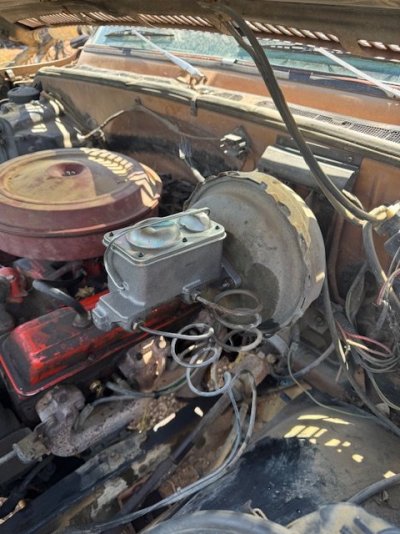
Changed the master cylinder. Pretty straightforward and easy job until the driver bleed valve snapped. I bled from furtherest to closest distance from MC like we do in the toyota world. So the driver was the final one and of course it snapped off. Even after i blasted it with pb blaster.

Nevertheless, i bought a new caliper. I was probably going to end up replacing them down the line.

Now a single lug is giving me trouble. My breaker bar puts an odd angle on it so the nut started to round out. I have been soaking it with pb blaster and even still my brushless dewalt 1/4” hex impact wasnt powerful enough. I ordered a Milwaukee 1/2” torque impact to try and break it loose. I figured if i need it once, ill need it again

Should arrive later this week. I’ll report back more afterwards.
 

Attachments
  • IMG_8469.jpeg
    IMG_8469.jpeg
    83.1 KB · Views: 42
Last edited:

killerpiller

Full Access Member
Joined
Aug 17, 2025
Posts
315
Reaction score
325
Location
colorado
First Name
And
Truck Year
1980
Truck Model
k10
Engine Size
5.7l 250sbc
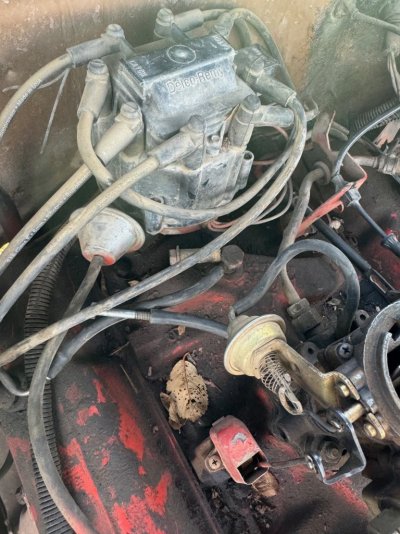
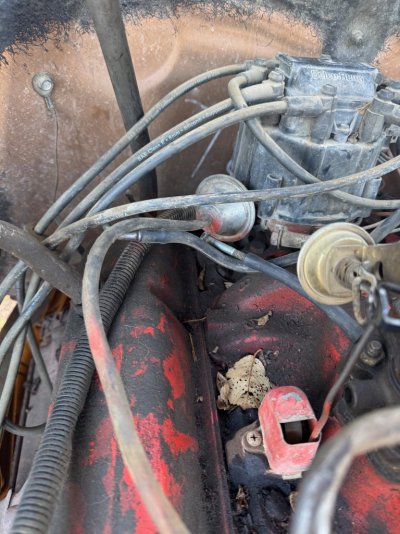
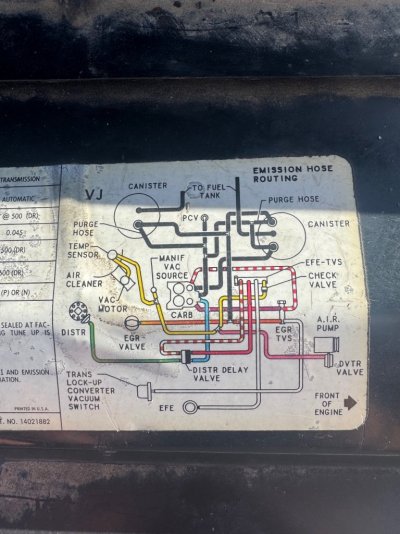
I am also chasing vacuum lines. Many have been removed, snipped or capped. So i am working to understand what in the diagram exists, what doesnt and what is rerouted. Vacuum lines are a new challenge to me so it is a learning opportunity. I want the truck to run cleanly but i feel like i dont need to replace everything in the diagram. I just need make sure what needs to be there is there and routed correctly.

During this process, i can tell the carb is not factory but yet a holley rebuilt carb. It seems that it’s vacuum connections are fewer than the factory diagram shows.

I am open to new carb recommendations but maybe i can clean this one.

Holley Rebuilt - Holley Carburetors 64-7177


More to come soon.
 
Last edited:

killerpiller

Full Access Member
Joined
Aug 17, 2025
Posts
315
Reaction score
325
Location
colorado
First Name
And
Truck Year
1980
Truck Model
k10
Engine Size
5.7l 250sbc
I need to replace the PVC vent from the valve cover. Currently, it is a hard tube. I’d like to go to a soft tube but having trouble finding a replacement hard or soft option.

I will also replace all vacuum lines. I suspect a couple rolls of different internal diameters should do the trick. Anything special with these or can amazon save the day?

Research continues
 

killerpiller

Full Access Member
Joined
Aug 17, 2025
Posts
315
Reaction score
325
Location
colorado
First Name
And
Truck Year
1980
Truck Model
k10
Engine Size
5.7l 250sbc
Vacuum game continues..

I dont see an EGR valve but i also dont see an EGR block off plate. Is there something I am missing? Could it be a replacement intake manifold without the mounting location for the EGR?

Note: i dont think it is under the leaf
 

Attachments

  • carb - back - above - 1.jpg
    carb - back - above - 1.jpg
    193.5 KB · Views: 30
  • dist - side - pass - 1.jpg
    dist - side - pass - 1.jpg
    188.6 KB · Views: 34
  • vac - diagram.jpg
    vac - diagram.jpg
    162.5 KB · Views: 41
  • intake manifold - above (part number).jpg
    intake manifold - above (part number).jpg
    198.7 KB · Views: 35

killerpiller

Full Access Member
Joined
Aug 17, 2025
Posts
315
Reaction score
325
Location
colorado
First Name
And
Truck Year
1980
Truck Model
k10
Engine Size
5.7l 250sbc
Off of an older vehicle probably.
I think so too. I think it is the same with the carb. Since it is an 1980, it seems to be an inbetween model. There seems to have been alot of changes made in 1981. I have noticed that this model aligns with the 1979 model on some things and a 1981 on others. For example, the oil dipstick is on the driver side which from my reading, is a feature of the 1979 but as per any "put in your vehicle details and we will show applicable parts" websites, the 1980 was supposed to have a passenger side oil dipstick.

I need to find the casting numbers for the block but they are hard to find without pulling the engine.

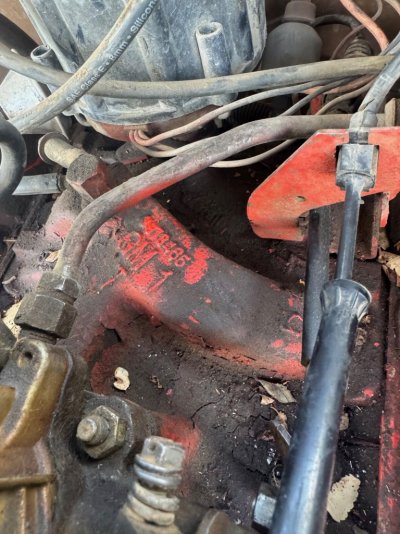
Here is the casting number for the intake manifold but it is still hard to read:

You must be registered for see images attach
 

killerpiller

Full Access Member
Joined
Aug 17, 2025
Posts
315
Reaction score
325
Location
colorado
First Name
And
Truck Year
1980
Truck Model
k10
Engine Size
5.7l 250sbc
After reviewing photos of my engine, the emissions diagram under the hood, reading the haynes manual (very helpful btw) and youtube videos, i believe i have the CURRENT STATE of my Vacuum System documented.

Only question i have is about the trans hose. There is a soft-hard-soft line running from the main vacuum source that i need to chase.

Any recommendations to changes or improvements to the vacuum system? Since many of the hoses are old and brittle, I will be changing all the hoses to ensure there are no leaks. Happy to take recommendations into account. I am a newb with vacuum systems.

soft-hard-soft line running from the main vacuum source
You must be registered for see images attach


Vacuum System - Current State

You must be registered for see images attach
 

killerpiller

Full Access Member
Joined
Aug 17, 2025
Posts
315
Reaction score
325
Location
colorado
First Name
And
Truck Year
1980
Truck Model
k10
Engine Size
5.7l 250sbc
I think so too. I think it is the same with the carb. Since it is an 1980, it seems to be an inbetween model. There seems to have been alot of changes made in 1981. I have noticed that this model aligns with the 1979 model on some things and a 1981 on others. For example, the oil dipstick is on the driver side which from my reading, is a feature of the 1979 but as per any "put in your vehicle details and we will show applicable parts" websites, the 1980 was supposed to have a passenger side oil dipstick.

I need to find the casting numbers for the block but they are hard to find without pulling the engine.

Here is the casting number for the intake manifold but it is still hard to read:

You must be registered for see images attach
Now that i typed this out, it is possible the engine was swapped to an older engine at some point. Wont know for sure till i verify the casting number
 

bucket

Super Moderator
Staff member
Moderator
Joined
Aug 3, 2010
Posts
35,125
Reaction score
43,720
Location
Usually not in Ohio
First Name
Andy
Truck Year
'77, '78, '79, '84, '88
Truck Model
K5 thru K30
Engine Size
350-454
That's an older engine. Hints are the 2bbl carb and the orange paint. If you remove the alternator and look for numbers stamped on the flat pad on the block's deck surface, it can possibly be pinpointed where that engine came from.
 

killerpiller

Full Access Member
Joined
Aug 17, 2025
Posts
315
Reaction score
325
Location
colorado
First Name
And
Truck Year
1980
Truck Model
k10
Engine Size
5.7l 250sbc
That's an older engine. Hints are the 2bbl carb and the orange paint. If you remove the alternator and look for numbers stamped on the flat pad on the block's deck surface, it can possibly be pinpointed where that engine came from.
thanks.. i will do this. did 1980 350s come with 4bbl carbs? According to the trucks vin, it came with a 5.7l v8 350sb. Other than emissions or irreparable damage, i am trying to think why someone would replace an engine with the same one.


Edit: Chatgpt answered this question for me... the plot thickens. Thanks for the direction!

For a 1980 Chevy K10 with the 5.7L V8 (350 small block), the stock carburetor setup depended on the exact engine option and emissions package:


  • Base 350 (5.7L) V8 → typically came with a 4-barrel Rochester Quadrajet carburetor from the factory.
  • Lower-output small blocks (like the 305) were more often paired with 2-barrel carbs. By 1980, the 350 in trucks was almost always a 4-barrel to meet power and emissions requirements.

So your K10 350 (5.7L) from the factory would have had a 4-barrel Rochester Quadrajet carb, not a 2-barrel.

On Chevy small blocks in trucks like your K10:
  • Through the early–mid 1970s, you could still find 350s with 2-barrel Rochester 2GC carbs as the base engine in pickups and Blazers. The 4-barrel Rochester Quadrajet was the higher-output option.
  • By the late 1970s (around 1977–1978), GM phased out the 2-barrel on the 350 for light trucks. The 350 became a 4-barrel-only engine for C/K pickups by 1979–1980.
  • The smaller 305 V8 and inline-6 engines carried the 2-barrels into the early 1980s, but not the 350.

Yes — Chevy definitely painted engines from the factory, and the color depended on the year and application:
  • 1950s–1970s → Most Chevrolet small-blocks and big-blocks were painted Chevy Orange (a bright red-orange). That’s the classic color most people think of when they open the hood on an older Chevy.
  • Mid/late 1970s → GM started shifting away from orange. Around 1977–1978, many truck engines began coming in corporate GM Blue instead of orange.
  • 1980s → By the time your 1980 K10 with the 350 (5.7L) rolled off the line, the factory engine color was GM Corporate Blue, not orange or red.
So:
A 1980 K10 350 would not have come from the factory in orange or red — it would have been blue. If you see one that’s orange or red, it’s either been repainted, or it’s an older replacement engine from the ’60s/’70s era.
 
Last edited:

killerpiller

Full Access Member
Joined
Aug 17, 2025
Posts
315
Reaction score
325
Location
colorado
First Name
And
Truck Year
1980
Truck Model
k10
Engine Size
5.7l 250sbc
Welcome,
All the books you need are on this site in the tech reference library.
there is a lot to digest on this site. Happy to be here. I also have a haynes manual that has been very helpful because it has lots of photos.. i can read photos better than words.
 

Ricko1966

Full Access Member
Joined
Apr 11, 2017
Posts
9,954
Reaction score
19,101
Location
kansas
First Name
Rick
Truck Year
1975
Truck Model
c20
Engine Size
350
Changed the master cylinder. Pretty straightforward and easy job until the driver bleed valve snapped. I bled from furtherest to closest distance from MC like we do in the toyota world. So the driver was the final one and of course it snapped off. Even after i blasted it with pb blaster.

Nevertheless, i bought a new caliper. I was probably going to end up replacing them down the line.

Now a single lug is giving me trouble. My breaker bar puts an odd angle on it so the nut started to round out. I have been soaking it with pb blaster and even still my brushless dewalt 1/4” hex impact wasnt powerful enough. I ordered a Milwaukee 1/2” torque impact to try and break it loose. I figured if i need it once, ill need it again

Should arrive later this week. I’ll report back more afterwards.
Front bleeders on GM calipers,I drill them out,tap the hole and replace them with Wilwood bleeders,you don't even have to pull them off the truck. If anyone needs more info hit me up just before you do it on your own thread.
You must be registered for see images attach
 

killerpiller

Full Access Member
Joined
Aug 17, 2025
Posts
315
Reaction score
325
Location
colorado
First Name
And
Truck Year
1980
Truck Model
k10
Engine Size
5.7l 250sbc
Front bleeders on GM calipers,I drill them out,tap the hole and replace them with Wilwood bleeders,you don't even have to pull them off the truck. If anyone needs more info hit me up just before you do it on your own thread.
You must be registered for see images attach
Thats a good idea. I figured because these calipers are so old they are due for a replacement. New caliper was only $40. Are the chevy oem calipers good enough to drill and retap or is it a bandaid? I know it depends on condition of calipers. Mine dont look like they have ever been replaced.
 

Forum statistics

Threads
48,416
Posts
1,066,933
Members
42,801
Latest member
rafamartz
Top