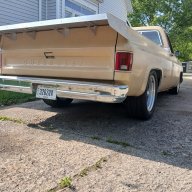
LED Tail lights now slow blinkers

Disclaimer: Links on this page pointing to Amazon, eBay and other sites may include affiliate code. If you click them and make a purchase, we may earn a small commission.

elimin8tor65

Junior Member
Joined
Oct 10, 2025
Posts
8
Reaction score
25
Location
Texas
First Name
Barry
Truck Year
1987
Truck Model
C10
Engine Size
350
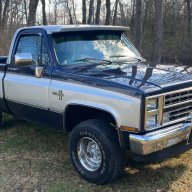
Hi all. Well, I installed LED tail lights. Tail lights work, brake lights work, reverse lights work. I've heard of hyper flash with regard to turn signals but not slow to no blinking at all. That's what's going on with my 87 silverado. Left blinker barely flashes and the right nothing. I've read that I could need to replace my relay with an electronic/led one that has a ground wire. Am I heading down the right path here? Any help appreciated.
 

YakkoWarner

Full Access Member
Joined
May 29, 2024
Posts
644
Reaction score
1,051
Location
Central Texas
First Name
Wolf
Truck Year
1989
Truck Model
R2500 Suburban
Engine Size
454
On my British car project, even after swapping to the electronic flasher I had to revert the in-dash indicator lamps back to the small incandescents - using 100% LEDs drew too little power for even the electronic unit to detect. With the incandescents back in the panel it worked properly.

Since you only replaced the tail light bulbs, the front indicators and in-dash indicators being incandescent should allow the electronic style flasher relay to work properly.
 

TotalyHucked

Full Access Member
Joined
Feb 24, 2020
Posts
6,953
Reaction score
25,663
Location
Auburn, Georgia
First Name
Zach
Truck Year
1985
Truck Model
Sierra 1500
Engine Size
5.3
I've never heard of LEDs causing a slow blink or nothing at all. Usually they cause either hyper flash or for the tail light to just be full on all the time. I would be checking the wiring and make sure you don't have a ton of resistance back there. You may have a ground issue
 

75gmck25

Full Access Member
Joined
Oct 13, 2016
Posts
2,756
Reaction score
3,047
Location
Northern Virginia
First Name
Bruce
Truck Year
1975
Truck Model
K25 Camper Special TH350 NP203
Engine Size
5.7
Bimetallic (old school) relays rely on having enough current through them so that the two metals inside expand differently and make the clicker go back and forth.

The TS switch runs current through the TS relay and the turn signal lights come on. The flowing current eventually makes the internal bimetallic strip move to one side because the two metals expand at different rates. When the strip moves it breaks the connection and there is no current flowing (lights go off). Then the strip eventually cools down and pops back the other direction, and current flows again. Rinse and repeat.

Bottom line - if there is not enough current flowing, the relay will not heat the bimetallic strip enough, and it will not cycle the lights. LED lights do not flow enough current for an old school turn signal relay.
 

Redfish

Full Access Member
Joined
Nov 6, 2021
Posts
3,750
Reaction score
19,681
Location
Prairieville, LA
First Name
Andrew
Truck Year
1987
Truck Model
V1500
Engine Size
350/5.7
You can install these:

You must be registered for see images attach
 
Joined
Jul 20, 2021
Posts
927
Reaction score
3,376
Location
Tennessee
First Name
Matt
Truck Year
1979
Truck Model
C10
Engine Size
6.17775926 liters, 3L80, 228.6mm axle
On my British car project, even after swapping to the electronic flasher I had to revert the in-dash indicator lamps back to the small incandescents - using 100% LEDs drew too little power for even the electronic unit to detect. With the incandescents back in the panel it worked properly.

Since you only replaced the tail light bulbs, the front indicators and in-dash indicators being incandescent should allow the electronic style flasher relay to work properly.
Same on my square and I think this is why mine works without any other extras like load equalizers or wiring when a lot of people have issues with LEDs. Not a big deal having the interior flashers incandescent to me.
 

Copymutt

Full Access Member
Joined
Jan 17, 2020
Posts
236
Reaction score
714
Location
Colorado
First Name
Jim
Truck Year
74
Truck Model
K20
Engine Size
350
using resistors to create the required load will work, but they get so hot you cant touch them. Kinda defeats the purpose in going to LED. Wander over to SuperBright & explore options.
 

YakkoWarner

Full Access Member
Joined
May 29, 2024
Posts
644
Reaction score
1,051
Location
Central Texas
First Name
Wolf
Truck Year
1989
Truck Model
R2500 Suburban
Engine Size
454
Superbright is who I got all the LEDs for the British car from - they even had the tiny old-school screw-in bulbs as LED replacement. The main reason to go LED was to take electrical load off of the 50+ year old wiring - putting 6 ohm resistors in the system would just bring the current draw back up.

The small draw from the panel incandescents is enough to trip the electronic flasher and still keeps the vast majority of the current draw down. Also had to keep the tiny incandescent for the alternator warning lamp on that particular vehicle, since its circuit design depends on minimal amounts of currrent flowing in the reverse direction thru the bulb when properly charging. All goes to show how ingenious the engineering of our older vehicles was (like GM's alternating side and front flashers) and how new and old technology can sometimes cause undesired side effects.
 

Ontheboulder

Full Access Member
Joined
Feb 27, 2022
Posts
436
Reaction score
863
Location
colville,wa
First Name
greg
Truck Year
1987
Truck Model
gmc sierra classic v2500
Engine Size
350
Hi all. Well, I installed LED tail lights. Tail lights work, brake lights work, reverse lights work. I've heard of hyper flash with regard to turn signals but not slow to no blinking at all. That's what's going on with my 87 silverado. Left blinker barely flashes and the right nothing. I've read that I could need to replace my relay with an electronic/led one that has a ground wire. Am I heading down the right path here? Any help appreciated.
I put all LED in my 87 gmc, try an electronic flasher. Mine blink normally
 

xm20k

Runs on 93 octane, caffeine, and spite
Supporting Member
Joined
May 26, 2025
Posts
1,111
Reaction score
2,855
Location
Girard, Ohio
First Name
David
Truck Year
78
Truck Model
c10
Engine Size
388
Mine work with the electronic flasher I also have all lights LED and no dash indicators.
Be aware you may need to flip the polarity on the flasher the one I use comes with the adaptor to flip it if it needs it.


PrairieDrifter

Full Access Member
Joined
Dec 28, 2014
Posts
4,731
Reaction score
8,013
Location
North Dakota
First Name
Mason
Truck Year
84,79,77,76,70,48
Truck Model
Suburban k10, bonanza k10, k30, k20, c10, gmc 1/2ton
Engine Size
350, 350, 350, 350, 350, 350
Same on my square and I think this is why mine works without any other extras like load equalizers or wiring when a lot of people have issues with LEDs. Not a big deal having the interior flashers incandescent to me.
The leds I had were too bright for the indicators anyways. Getting blinded by the green goblin :rofl:
 

Dejure

Full Access Member
Joined
Mar 3, 2025
Posts
477
Reaction score
925
Location
Eastern Washington
First Name
Kelly
Truck Year
1978
Truck Model
C15
Engine Size
350
You can install these:

You must be registered for see images attach


BUT, know that, while resistors tend to be more trustworthy than incandescents AND LED's, the resistor will increase the load in the circuit. The WHOLE purpose of installing it - to add more load to the circuit, WHILE running the longer lived LED's that, hopefully, hold up better.

SIDE NOTE1: LED'S need heat dissipation, just as did the fluorescent swaps that died, seemingly overnight, WHEN all the heat was trapped in globes and such.

Adding the resistor out in the open will be a game changer, just put it where it can dump its heat, to stay alive.

SIDE NOTE2 [A bastard comparison]: Consider heater circuits: Some systems for heater controls use relays on only one of the switch positions. The high speed circuit. This is done under the erroneous presumption running the power through resistors negate the need for relays.

In truth, the resistor is just a dump for some of the power going through the high speed circuit. It does not reduce the power in the circuit. The circuit still sees the power consumed by the high switch position. It just dumps the power needed to run the other circuits (lower speed circuits) across resistors that, in combination with the resistance of the blower motor, result in lower blower motor speeds. IT DOPES NOT take a load off the switch.

HOWEVER,

 

Broken85

Supporting Member
Supporting Member
Joined
Jan 14, 2024
Posts
296
Reaction score
408
Location
Cumberland, NJ
First Name
A
Truck Year
1985
Truck Model
K10
Engine Size
350
I’d be curious what the OP posts back after he gets a digital flasher and go from there. I have had led bulbs barely twinkle on a blinker circuit. LEDs make a lot of stuff get goofy, especially if you use cheap LEDs.

BTW, you need two new flasher modules. One for the blinkers and one for the hazards.
 

xm20k

Runs on 93 octane, caffeine, and spite
Supporting Member
Joined
May 26, 2025
Posts
1,111
Reaction score
2,855
Location
Girard, Ohio
First Name
David
Truck Year
78
Truck Model
c10
Engine Size
388
I’d be curious what the OP posts back after he gets a digital flasher and go from there. I have had led bulbs barely twinkle on a blinker circuit. LEDs make a lot of stuff get goofy, especially if you use cheap LEDs.

BTW, you need two new flasher modules. One for the blinkers and one for the hazards.
Not always my hazards run on a standard flasher as all 6 lights flash it's enough load for them to work.
 

Forum statistics

Threads
48,414
Posts
1,066,921
Members
42,801
Latest member
rafamartz
Top