Heater not working but blower motor working just fine.

Disclaimer: Links on this page pointing to Amazon, eBay and other sites may include affiliate code. If you click them and make a purchase, we may earn a small commission.

Christie

Junior Member
Joined
Mar 1, 2024
Posts
5
Reaction score
8
Location
Dawson Creek, BC Canada
First Name
Christie
Truck Year
1977
Truck Model
C 10
Engine Size
350
So my heat/defrost is not blowing in any air but my actual blower fan seems to be working just fine. However I was told that my wire keeps melting by the previous owner (hopefully this makes sense to someone). If you know what I’m trying to describe please help. It’s currently -23 degrees Celsius here. Having heat would be awesome right now.
 

RanchWelder

Full Access Member
Joined
Jan 14, 2023
Posts
947
Reaction score
1,330
Location
Earth
First Name
--------
Truck Year
87
Truck Model
Blazer
Engine Size
350ci
1) Make certain your ground wire to your battery is not covered with acid and corroded.

2) Look for a ground strap from your engine block heads, to your fire wall.

You must be registered for see images attach


If you have one, move on. If you do not have one, either add one or run a wire from your negative battery terminal to a new screw on the fire wall, for now. Use a self tapper, and a washer and scrape the paint off wherever you add one. Try not to screw into anything important?
Find a blank spot on the passenger's side not inside the heater box, if possible.

If you have a ground to the fire wall...

3) Could be this.
Heater Resistor module is failing:
You must be registered for see images attach

Make certain the connector is not burned up or melted.
If you have an ohm meter, you can check the coils across the terminals and verify they all have different resistance values.
You can see where each coil connects through the housing to a terminal.
Each wire is different length so each blower setting changes the fan speed.

4) If you need a new connector, see the link below and find the correct one.

5) If the coils are melted, broken or touching, then try to bend them away from each other or buy a new unit before you move forward.
If you have a dead rodent in there, now's the time to get it out.

If it looks good and not burned up, you just saved yourself buying the resistor unit!

6) Or this dash switch:
Same same, make certain the connector is not broken or melted.
These fail or short circuit. If yours is original, replace it so every other test works correctly.
You must be registered for see images attach


7) This might be under the hood:
Make certain it's not melted or the wiring to the firewall has not been damaged, cracked, hacked up or broken.
If it is, you'll need the wiring connector as well. It's a relay and handles high voltage. Buy one and be certain it's good.
(See the link below and search electrical connectors).
You must be registered for see images attach


Check here for the parts:

https://www.rockauto.com/en/catalog....7l+350cid+v8,1030217,heat+&+air+conditioning

Find part numbers from ACDelco or Standard Motor Products, if you can afford them.
Most stuff will work OK from the better brands.
Cheaper stuff might not last too long, but will get you by.

After you replace these things, change the fuses for the heater system and make certain the wires from the blower to the dash controls are not broken, cut and taped or accidentally hitting the metal dash.

You might need to carefully remove the glove box screws and get a flash light behind the radio or open the dash covers to inspect the connectors and the wiring, properly.

If the blower was bad you should be seeing a blown fuse or hear the bearings screaming, the fan making bad noises or smell's; like burning.
If somebody hot wired the fan motor without a fuse directly to the fuse panel, you'll see it when you check the fuse box.
Hot wiring the fan is a no-no.

Radio mods can cause these issues, if there's old wiring hanging around and shorting things out.

Make certain the correct amperage fuses are in the system before you move forward.
Look for blown fuses first.

If the fuses are blown replace the switch parts from above and reinstall new fuses, after you replace the electrical bits above.
Fan resistor could cause the others to go bad in sequence.

The best way to repair the system is to repair everything I showed you, or anything shorting can cause each item to break again.
Your connectors are very old. Stuff breaks down since 1977.

There might be a ground wire missing from behind the dash near the ash tray.
Look for a broken floating black wire and attach it to any screw it will wrap around under the dash.

Lots of times, that ground wire was attached to the push button lighter.
If it's blown or the ground is broken from a 20 year old radio mod, then find the ground, remove the lighter push button full of crud and tape off any loose wires you see with no place to go, so they don't short out on the metal dash.
The lighter circuit can be eliminated and taped off, so it doesn't cause a problem.
If it's full of dirt, then disconnect the lighter and tape it up.

Next spring you fix everything?

 
Last edited:

Christie

Junior Member
Joined
Mar 1, 2024
Posts
5
Reaction score
8
Location
Dawson Creek, BC Canada
First Name
Christie
Truck Year
1977
Truck Model
C 10
Engine Size
350
RanchWelder,
Thank you so very much. I’ll look into this when the weather gets warmer here in the next couple weeks. I really appreciate your attention to detail and walking me through each scenario.
 

DrvnDrvr

Full Access Member
Joined
Jan 30, 2022
Posts
187
Reaction score
585
Location
Central Oregon
First Name
Al
Truck Year
78
Truck Model
K20
Engine Size
350
Have you removed the fan and checked that a critter hasn't got in and made a nest in the heater chamber?
 

RanchWelder

Full Access Member
Joined
Jan 14, 2023
Posts
947
Reaction score
1,330
Location
Earth
First Name
--------
Truck Year
87
Truck Model
Blazer
Engine Size
350ci
The rodent issue was already mentioned.
If you have a rat, and you turn on the blower, you'll know it, unless you cannot smell anymore.
If you smell a rat, clean the duct work before you get sick.

They can get way inside of the system.
You might have to remove all the duct work and wash it all out with vinegar.

You Got this!
 

75gmck25

Full Access Member
Joined
Oct 13, 2016
Posts
2,786
Reaction score
3,099
Location
Northern Virginia
First Name
Bruce
Truck Year
1975
Truck Model
K25 Camper Special TH350 NP203
Engine Size
5.7
The lower blower speeds go through the resistor pack, and the high speed is a direct connect through a separate fuse. The separate high speed fuse is in a wire that runs across the top of the firewall from the junction next to the brake booster over to the blower relay. My ‘75 GMC kept frying the fuse holder, so I spliced in a new fuse holder with a blade fuse. It’s been fine since then.

To check inside the plenum and pull out debris :
- remove the glove box door. Find screws that go directly up through the flange.
- remove the vertical plastic piece right in the middle of the plenum
- look/reach inside the plenum and clean out the junk. It will,be a treasure trove. Move the heat control back and forth to verify that the blend door cable moves and routes air through the heater core. With the truck running, put your hand next to the heater core to verify it is getting hot.
Assuming you have A/C, also check to see that the vacuum-operated doors move as you switch the controls.
 

RanchWelder

Full Access Member
Joined
Jan 14, 2023
Posts
947
Reaction score
1,330
Location
Earth
First Name
--------
Truck Year
87
Truck Model
Blazer
Engine Size
350ci
It's 2% of what you don't know that kills your heater

75gmck25

Great advice!​

The vacuum system flappers could be blocked, like he suggested^^^.

Deleted my entire old school heater duct system and made my own blower module.
Kept the upper plastic duct and removed everything else.
Deleted my A/C condenser and blocked off the firewall openings completely.
Rewired everything 12 gauge with extra fuses, everywhere.

It's not hard to rebuild these older systems. It just takes commitment.

Lil' aluminum, lil' skills at bending some metal and drilling a few rivets, crimping a few fuse holders correctly; you can rewire and make it very good.

Used my old heater core.
My heat is amazing, without the resistor module at high heat, high blower, all the time.
Used a rubber tire tube, cut to length with super zip ties, to match my new fabricated aluminum bent metal heater blower unit to duct my plastic upper dash duct work.

Installed a 3/4" ball valve in the heater supply hose from the engine block, so I can shut it off from recirculating through the heater core, in the summer time.

It works great in Montana in -35.
Defroster rock's.

Rewiring the entire system with modern wire, adding extra under dash fuses and switches for semi-truck blower controls worked great.
I use a Kenworth push pull switch on my dash, with new fuse holders and properly crimped connectors.

My truck is old. Anything I can improve with off the shelf USA made Semi-tractor trailer parts and switches, (which are made to last decades), is what I use when I get rid of the OEM vacuum and B/S system switches.

YMMV.

Hope this helps.
If you want pictures or wiring diagrams, please email me directly.
I can post here if it does not take over your thread, if you like.
 
Last edited:

Dejure

Full Access Member
Joined
Mar 3, 2025
Posts
492
Reaction score
949
Location
Eastern Washington
First Name
Kelly
Truck Year
1978
Truck Model
C15
Engine Size
350
Year old thread, but things that show up on a search get read. Accordingly, clarifications and corrections are important.

I am not familiar with AC systems, but I suspect they are the same as non-AC systems of this year, which only use one fuse feeding to the low speed position on the control panel switch (thus the always on thing).

To be clear, it would make no sense to have more than one fuse for the heater circuit, since all switch positions consume the same amount of power. The difference between the positions is, all the VOLTAGE is delivered to the blower in the high position, and part of the VOLTAGE is dumped across the resistors in the medium and low positions. Power (WATTAGE) consumption would be the same in each position, so the same sized fuse would be needed for all positions.

CORRECTION (thanks Ricko and others): Many talk about their systems having relays [that take the load off the switch (reduced power through it)].

Circuits that incorporate relays are an entirely different approach than just running through a switch. For relay type heater controls, you'd need a fuse in the line feeding the speed control switch, AND a fuse in the feed to the relay, to protect the wire coming directly from the battery.

SIDE NOTE: Excluding the already fused wire to the control panel switch and going to the relay to control it, all the wires to and from the relay should be the same gauge, and fused appropriately for their gauge.

Systems that do not use a relay (the speed control switch wires straight to the heater resister, as explained below), only use one fuse. That fuse is in the fuse block and protects all the downstream wires.

NOTE: The fuse should protect the smallest gauge wire(s) in the circuit.
 
Last edited:

Ricko1966

Full Access Member
Joined
Apr 11, 2017
Posts
10,175
Reaction score
19,672
Location
kansas
First Name
Rick
Truck Year
1975
Truck Model
c20
Engine Size
350
Year old thread, but things that show up on a search get read. Accordingly, clarifications and corrections are important.

I am not familiar with AC systems, but I suspect they are the same as non-AC systems of this year, which only use one fuse feeding to the low speed position on the control panel switch (thus the always on thing).

To be clear, it would make no sense to have more than one fuse for the heater circuit, since all switch positions consume the same amount of power. The difference between the positions is, all the VOLTAGE is delivered to the blower in the high position, and part of the VOLTAGE is dumped across the resistors in the medium and low positions. Power (WATTAGE) consumption would be the same in each position, so the same sized fuse would be needed for all positions.
They use 2 separate circuits not 1, high is a separate circuit and has its own fuse,the switch triggers a relay which provides a separate 12v source to the blower motor.
 

Dejure

Full Access Member
Joined
Mar 3, 2025
Posts
492
Reaction score
949
Location
Eastern Washington
First Name
Kelly
Truck Year
1978
Truck Model
C15
Engine Size
350
This may be true with some, such as those using relays, but it is not true with those that rely solely on the control switch.

As I noted, my 1978, without air (I haven't looked into those at all), AND without a relay, and that have three or four speeds, have a single fuse.

There is no logical reason for more than one fuse. There is only 1 hot wire coming from the battery.

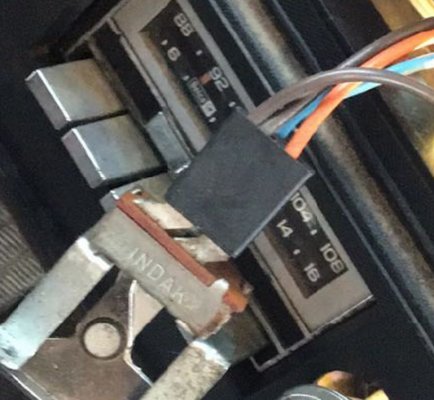
For example, consider the attached photo of the stock control panel connector configuration. Note the 2 brown wires going to one connector terminal: 1 comes from the fuse, and the other goes to the blower resistor low speed terminal on the blower resistor. This is how Detroit designed the system to make the low speed always on when the key is in the run position (fuse energized).

On that connector panel connector, the blue goes to the medium speed terminal of the blower resistor and the orange goes to the resistor output terminal, which, also, has a wire to the blower, so the resistor is, electrically, bypassed to give the blower full voltage, when that wire is energized by the control switch.

For those unaware, though fuses are rated in amps, it is not the amperage that takes them out. It is the wattage (circuit amperage times circuit volts).

Though a fuse may say 5 amps, you could run a hundred amps through it, if the voltage was, say, one half a volt (50 watts of heat).

You could use the 5 amp fuse in a 24 volt (two 12 volt batteries connected in series) system, but the line it was protecting would have to feed a device using half the amperage the 12 volt version uses (on that wattage, again, when you double voltage, amperage is cut in half).

In these heater circuits the wattage in all three, or four positions, is the same. The ONLY thing that changes is, some of it is dissipated across resistors when the voltage is dropped across them, to supply a lower voltage to the motor for speed control. Accordingly, you would need the same fuse capacity for low, medium and high.

When you dive into research on these heater circuits, such as searches on this site, you'll note people talking about relays too. However, my 78 and a good many others do not use relays, so the switches take less of a beating. Accordingly, this fact needs to be considered when you search for wire diagrams and schematics for your system. The same would apply to the multiply fuses some talk[ed] about, and which may apply to AC circuits.

Things that would change the amount of wattage across a fuse in these circuits, and would cause a properly sized fuse to to melt are:

(1) The blower motor going south (e.g., bad bearings, shorted windings).

(2) A positive wire shorted to ground.

NOTE: Generally, resistors never short. However, I had a bulb element (resistor) break and weld itself to the other 1157 bulb element (that made for some fun symptoms).

(3) A degraded connection.


IN THE END, there are completely different circuits. IF you use a relay, you'd need a fuse to the control switch, AND one to the relay for the power supplied to it from the battery [or for each relay, if more than one was used].


SIDE NOTE: As is elsewhere several times mentioned, the heater control switches are a week point of these systems and fail in a few years of use.

IF the relays on rigs using them are only used when the blower motor is on high (getting full voltage), it is likely the switches on those rigs don't hold up much longer under the same use as systems that don't use them.

This because the same amount of power is used in each switch position, but some of is dissipated across the resistor circuit when the switch is positioned to medium blower speed, and more is dissipated across the resistor when the switch is set to low.

Too, for the control switch to route current flow through the relay for the high speed blower speed, it would still have to go from low to medium before going to high.

In the end, it appears the ideal, insofar as switch life is concerned, would be use of relays for each speed, which would reduce failures of switches to just mechanical problems.

Consider the example of old point type ignition systems. Adding capacitive discharge systems reduced the amperage at the points from around 7 amps to a couple hundred milliamps resulting in the points wearing so long the rider wore out before point burning became a problem, but which was a problem with point type ignitions.
 

Attachments

  • Heat Cont Conn Config-Orig.jpg
    Heat Cont Conn Config-Orig.jpg
    69.3 KB · Views: 43
Last edited:

Jgonick

Full Access Member
Joined
Jan 12, 2017
Posts
572
Reaction score
752
Location
West Texas
First Name
Joel
Truck Year
1985
Truck Model
K10
Engine Size
350
I'm confused what is being discussed- maybe for clarification.

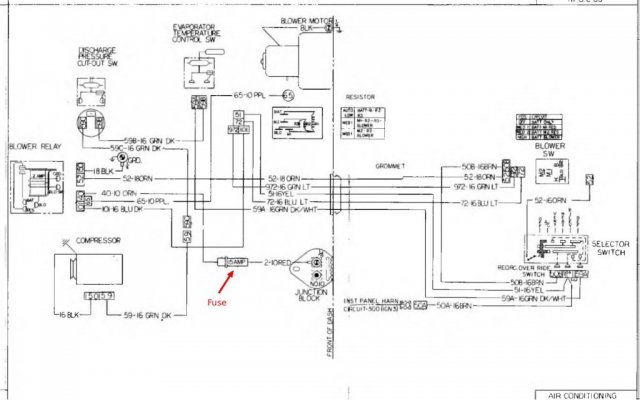
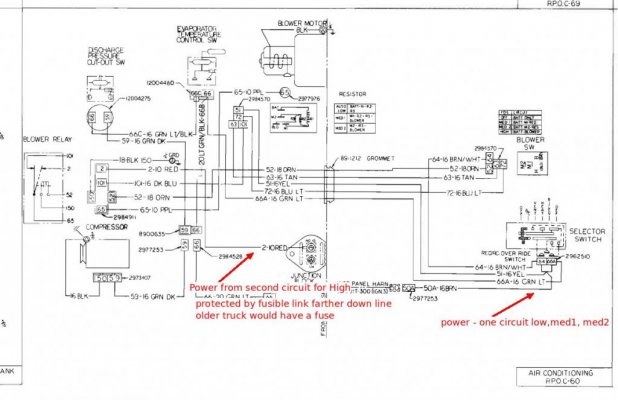
AC systems (typically) have one more blower speed and the highest speed gets it power through a relay from a different circuit. It come through the relay from the junction block and is protected by a separate fuse or a fusible link somewhere on that circuit (depending year).

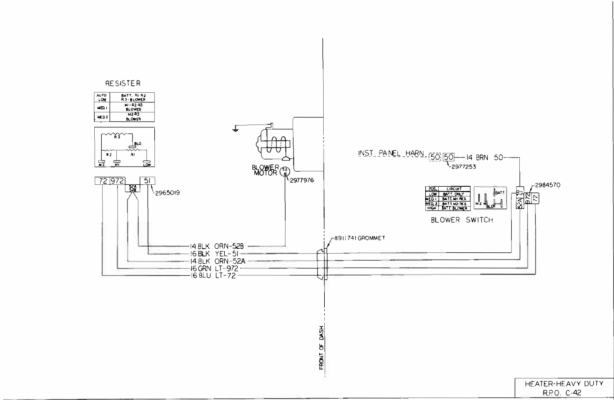
The low, med1, med2 on AC system - does use the same power source through a resistor circuit just like a Non-AC's low,med,high. The "heavy duty" heater does have a fourth speed (on older trucks) and it does go through the same resistor circuit. (no relay)

Attached are 78 AC and 73 AC(fuse), 78 heavyDutyheater
 

Attachments

  • 73.jpg
    73.jpg
    82.8 KB · Views: 47
  • 78.jpg
    78.jpg
    98.9 KB · Views: 45
  • 78h.png
    78h.png
    256.8 KB · Views: 36

Dejure

Full Access Member
Joined
Mar 3, 2025
Posts
492
Reaction score
949
Location
Eastern Washington
First Name
Kelly
Truck Year
1978
Truck Model
C15
Engine Size
350
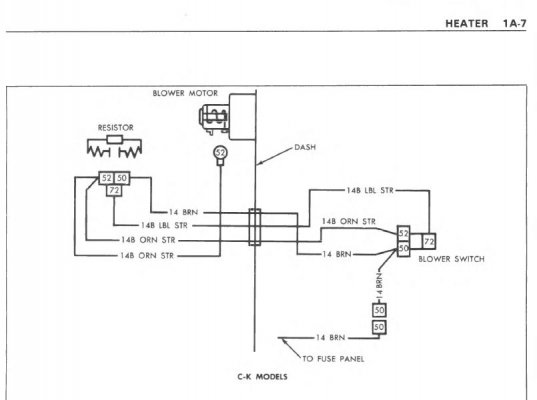
I made it VERY clear, the information I shared was about NON-AC SYSTEMS, like mine, that do not have a relay, and have ONLY ONE fuse.

We didn't know which system we were dealing with, so sharing factual information about both non-AC, non-relay systems made sense.

Unfortunately, just as I don't know everything [or even much] about how GMC set up its relay systems, it is obvious others are unfamiliar with non-AC/relay systems. Contrary to implications, they exist in plenty.

That GMC put out many systems that did not incorporate a relay is reflected in wire diagrams and schematics that do not show a relay in their system. The relays in the above schematics are hard to miss. Ones in non-relay systems are, on the other hand, impossible to find. A pretty critical omission, if they were used, because it wholly changes the wiring, as I noted, above (e.g., the relay requires another wire from the battery, and additional fuse protection).

I added details for those wishing to understand a bit more about the electrical whys and wherefores. Thus the explanation about the voltage and power drop across the resistor, bringing question to why a relay was only used in the high speed circuit.

As many of us learned over the decades, merely that Detroit, or their equivalent, did something does not mean it was the best practice. Often, things were done to save money, rather than with an eye to dependability, or ease of maintenance and care. Things like gas tanks with fuel pumps that are inaccessible unless the tank is dropped, rather than having a simple access plate, or hiding them under the intake manifold. . . .
 

Attachments

  • Heater No Relay-1.jpg
    Heater No Relay-1.jpg
    29.5 KB · Views: 31
  • Light Truck Manual 78.jpg
    Light Truck Manual 78.jpg
    89.6 KB · Views: 50
Last edited:

Latest posts

Forum statistics

Threads
48,666
Posts
1,074,187
Members
43,338
Latest member
jw23655
Top