Battery to body ground

Disclaimer: Links on this page pointing to Amazon, eBay and other sites may include affiliate code. If you click them and make a purchase, we may earn a small commission.

Ken B

Supporting Member
Supporting Member
Joined
Sep 18, 2019
Posts
1,378
Reaction score
2,120
Location
indiana
First Name
ken
Truck Year
81
Truck Model
c10
Engine Size
350
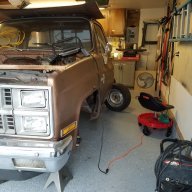
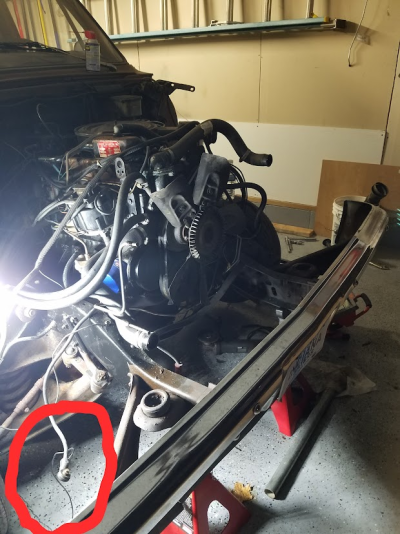
Forgive the old pic. the small battery to body ground wire circled in this pic. It was not hooked back up when the wiring harness was replaced.
Is there such a thing as too many grounds? Any reason why this would not have been re landed to the core support?
No i didnt do that wiring.
You must be registered for see images attach
 

Attachments

  • 1778363792053.png
    1778363792053.png
    771.6 KB · Views: 21

Ken B

Supporting Member
Supporting Member
Joined
Sep 18, 2019
Posts
1,378
Reaction score
2,120
Location
indiana
First Name
ken
Truck Year
81
Truck Model
c10
Engine Size
350
that was my thought....never too many. but just thought i would run the question past the experts in here.
 

Bennyt

Full Access Member
Joined
May 17, 2019
Posts
1,613
Reaction score
2,921
Location
Surprise
First Name
Ben
Truck Year
1977
Truck Model
C10
Engine Size
350
Somebody posted this a year or so back...
You must be registered for see images attach
 

EvilGenius

Full Access Member
Joined
May 12, 2016
Posts
276
Reaction score
270
Location
Metro Detroit
First Name
Darien
Truck Year
1983
Truck Model
K10
Engine Size
350
I've taken the approach of can't have too many ground on my k10. O'Reillys sells black battery cable with an eyelet on both ends for a good price. My setup is one of those under one of the nuts for the park brake cable running to the chassis on the driver side. Then another one running from the trans bell housing to the passenger side of the chassis. And from there to the battery.
 

Scruffy49

Full Access Member
Law Enforcement Navy
Joined
Feb 28, 2025
Posts
418
Reaction score
589
Location
Rosemark TN
First Name
Jeff
Truck Year
1985
Truck Model
C10 swb
Engine Size
4.3L
My 85 seems to have a few factory style extra ground straps… Frame to passenger rear cab mount area. Cab to bed header panel. Fuel filler screw to bed trim screw. Back bumper to frame rail.

Once I swap in the 350, will add an extra alternator bracket to frame ground, either 4g or preferably 2g. Alternator will be on the driver’s side, 1992 serpentine belt system.
 

WP29P4A

Full Access Member
Joined
Jul 18, 2021
Posts
927
Reaction score
1,611
Location
Nevada
First Name
Mike
Truck Year
1987
Truck Model
Sierra Classic V1500
Engine Size
350 TBI
Here is the pattern I have found after spending almost 50 years trouble shooting electrical wiring. The large ground cable from battery to engine block, or battery to alternator on GM products, is the most important ground because it's for the starter primarily, but also supplies the ground circuit for the rest of engine functions. It is NOT a good idea to reroute the circuit by going to the frame first, then back to the engine. Lengthening the cable and adding connections is not a logical option, if it was the factory would have done it that way. Virtually all manufactures used the same configuration for a reason. The main ground always goes straight to the engine. The second ground goes from battery to frame and usually the core support. The third ground goes from back of engine to firewall. On trucks because the frame is isolated from the bed, there will be a ground connecting the frame to the body, and a ground from cab to frame. This configuration changes slightly on uni-body cars that don't have a frame. The positive and ground on a vehicle are equally important, for some reason people with little knowledge of electrical act like grounds are just an extra precaution. Adding extra grounds just shows others that you don't understand how they actually work, there is no benefit.
The best visualization I can share is this. If one of your arms or legs was a completely different size than the other, would your body work symmetrically, or would you be favored to one side? Same concept with electrical. It is not a coincidence that the electrical wires in you house, hot neutral and ground are all the same gauge. If you're not going to install a second starter in the bed of the truck and use it to grind coffee beans you do not need fat grounds anywhere else. (Except maybe to the sub amp)

 
Last edited:

EvilGenius

Full Access Member
Joined
May 12, 2016
Posts
276
Reaction score
270
Location
Metro Detroit
First Name
Darien
Truck Year
1983
Truck Model
K10
Engine Size
350
Here is the pattern I have found after spending almost 50 years trouble shooting electrical wiring. The large ground cable from battery to engine block, or battery to alternator on GM products, is the most important ground because it's for the starter primarily, but also supplies the ground circuit for the rest of engine functions. It is NOT a good idea to reroute the circuit by going to the frame first, then back to the engine. Lengthening the cable and adding connections is not a logical option, if it was the factory would have done it that way. Virtually all manufactures used the same configuration for a reason. The main ground always goes straight to the engine. The second ground goes from battery to frame and usually the core support. The third ground goes from back of engine to firewall. On trucks because the frame is isolated from the bed, there will be a ground connecting the frame to the body, and a ground from cab to frame. This configuration changes slightly on uni-body cars that don't have a frame. The positive and ground on a vehicle are equally important, for some reason people with little knowledge of electrical act like grounds are just an extra precaution. Adding extra grounds just shows others that you don't understand how they actually work, there is no benefit.
The best visualization I can share is this. If one of your arms or legs was a completely different size than the other, would your body work symmetrically, or would you be favored to one side? Same concept with electrical. It is not a coincidence that the electrical wires in you house, hot neutral and ground are all the same gauge. If you're not going to install a second starter in the bed of the truck and use it to grind coffee beans you do not need fat grounds anywhere else.
While this is largely true, most people don't have the abilty nor desire to put the time into calculating all the various loads to determine the perfectly sized wire gauge for the shared ground path. The oem can do that. They are incentivised to do so for weight and cost savings. But for all us schmucks it's way easier to just buy a 6 gauge starter cable for $10 and slap it in for the ground cable. You can't over ground your electrical system, so doing this hurts nothing and ensures you don't accidentally undersize your ground path. Plus now you have flexibility if down the road you decide to add to your electrical load via new lights or new stereo.

The metaphor for different sized arms doesn't really work. It's more of a different diameter hose situation. You're limited by the smallest hose diameter in a chain of hoses. Which is still a flawed metaphor, but it's closer to reality than the arm comparison.
 

Scruffy49

Full Access Member
Law Enforcement Navy
Joined
Feb 28, 2025
Posts
418
Reaction score
589
Location
Rosemark TN
First Name
Jeff
Truck Year
1985
Truck Model
C10 swb
Engine Size
4.3L
My truck was most likely done that way to help with the CB added by the original owner. Since I have an analog CB and 102” stainless whip antenna, spring mounted to a stake pocket…? I’m keeping the “extra” ground straps to help with RFI and SWR issues, per the r/cbradios group. Even adding a ground strap/s back to the hood, can see where they used to be…
 

WP29P4A

Full Access Member
Joined
Jul 18, 2021
Posts
927
Reaction score
1,611
Location
Nevada
First Name
Mike
Truck Year
1987
Truck Model
Sierra Classic V1500
Engine Size
350 TBI
@EvilGenius You sound like someone that has very little experience but has a hard-on to make a weak point that helps no one. I never said you needed to do load calculations. I never said you shouldn't add as many decorative grounds as you can afford. The example of symmetrical in relation to both sides of the electrical system is accurate, because It wasn't about loads it was about importance. You missed the point, and twisted my words and message. Why would you do that? Do people pay you $100 an hour to fix their electrical problems? Do professionals seek you out to fix what they can't? Have you ever had a job correcting other peoples wiring problems? How many millionaire/billionaire clients do you have calling you a 9 o'clock at night asking for your advise?
 

idahovette

Full Access Member
Firefighter
Joined
Aug 7, 2016
Posts
9,541
Reaction score
22,410
Location
Weiser Idaho
First Name
Perry
Truck Year
1975-1979
Truck Model
K20-K10
Engine Size
350
Don't have spell check, huh?
 

ss454elco

Full Access Member
Joined
Apr 22, 2024
Posts
35
Reaction score
48
Location
Pennsylvania
First Name
Rod
Truck Year
1984
Truck Model
K10
Engine Size
350
In my opinion, you can't over ground your vehicle. The factory does the minimum necessary due to cost. More wires/larger gauge wires doesn't hurt. When I redid my 84 K10, I added more ground wires than original. Redundancy never hurts. Some call it overkill, I call it peace of mind.
 

DoubleDingo

Full Access Member
Joined
Jul 3, 2012
Posts
13,894
Reaction score
23,744
Location
Right where I am
First Name
Bagoomba
Truck Year
1981
Truck Model
81-C20 Silverado Camper Special-TH400-4.10s
Engine Size
Carb'ed Vortec 350

YakkoWarner

Full Access Member
Joined
May 29, 2024
Posts
643
Reaction score
1,049
Location
Central Texas
First Name
Wolf
Truck Year
1989
Truck Model
R2500 Suburban
Engine Size
454
Since grounds are usually made directly to iron or steel components that can corrode, having additional grounds is never a "bad" idea because you then have redundant paths, but it can confuse troubleshooting because you might be having your current going through different points than you think. In an ideal (from the factory) world, using only the original ground points as manufactured works just fine. In the real world, age and corrosion are a thing and an extra ground cable can frequently solve one of those "why do my instrument panel lights turn off when I press the brakes" kind of problems.

You don't even want to see how many extra grounding points I added to my British car project. It will drive the purists nuts, but every lamp, instrument, switch or other electrical device works perfectly now (except for that one bad hazard flash switch where the internal contacts don't always line up).
 

DoubleDingo

Full Access Member
Joined
Jul 3, 2012
Posts
13,894
Reaction score
23,744
Location
Right where I am
First Name
Bagoomba
Truck Year
1981
Truck Model
81-C20 Silverado Camper Special-TH400-4.10s
Engine Size
Carb'ed Vortec 350
Since grounds are usually made directly to iron or steel components that can corrode, having additional grounds is never a "bad" idea because you then have redundant paths, but it can confuse troubleshooting because you might be having your current going through different points than you think. In an ideal (from the factory) world, using only the original ground points as manufactured works just fine. In the real world, age and corrosion are a thing and an extra ground cable can frequently solve one of those "why do my instrument panel lights turn off when I press the brakes" kind of problems.

You don't even want to see how many extra grounding points I added to my British car project. It will drive the purists nuts, but every lamp, instrument, switch or other electrical device works perfectly now (except for that one bad hazard flash switch where the internal contacts don't always line up).
I added several extra grounds on Crusty Biscuit when I got it going. Not big honkin 0/0 gage cable hoses, just small wires from bulbs, 8 gauge from here or there to the body and frame. The big wires were up front where they belong. It's amazing how bright halogens sealed beams shine when provided with full 12 volts and proper grounding to each unit, and how well each circuit operated when properly grounded.
 
Top