
Tightening down front yoke nut stops NP205 from turning

Disclaimer: Links on this page pointing to Amazon, eBay and other sites may include affiliate code. If you click them and make a purchase, we may earn a small commission.

Mark80K15

Full Access Member
Joined
Apr 18, 2021
Posts
113
Reaction score
78
Location
Sicamous, BC
First Name
Mark
Truck Year
1980
Truck Model
K15
Engine Size
350
Hello, 1980 GMC K15 SM465/NP205. I broke the SM465/NP205 adapter, so I took the time to apply new NP205 seals/gaskets and the JB Fab twin stick setup. I didn't intend a full rebuild, but I wound up removing everything except the idler gear assembly. In fact the front shaft just kinda fell out (gently) at one point. I've never worked on NP205 before.

Replacing the shift rails went well. Since I had both the front and rear output assembly out, I could clearly see the 2 rails from the inside, the 2 shift forks, and the interlock rod. Seeing these and understanding how they work helped a lot in going through the rail replacement procedure. Once the roll pin is knocked out of the rail (3/16" punch), and the rail is clear of the interlock, there is nothing else touching the rail but the fork and the case itself. I found the passenger rail was kind of stuck in the fork, which probably causes the difficulty that others have reported. Just keep working the fork off the rail, it will come eventually. Brand new and without the roll pin, the rail slides through the fork effortlessly.

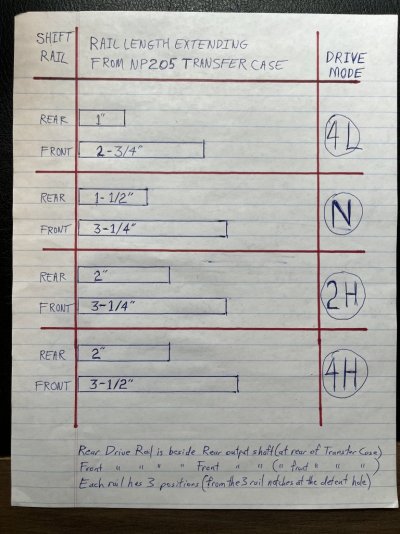
So I finished reassembling, applied gaskets and seals, and measured how far the modified rails (that came with the twin stick setup) protrude from the case in each NP205 shift position. The measurements were correct, (and the same as stock). I drew a guide which I posted here:
 

Attachments

  • my_shift_rail_length_diagram.JPG
    my_shift_rail_length_diagram.JPG
    153.5 KB · Views: 19

Mark80K15

Full Access Member
Joined
Apr 18, 2021
Posts
113
Reaction score
78
Location
Sicamous, BC
First Name
Mark
Truck Year
1980
Truck Model
K15
Engine Size
350
I confirmed that for each NP 205 driving position (4H, 2H, N, 4L), the rail position was correct, and the input/output shafts turned properly. For example, N has each shaft turning (or stationary) independently, 4L has input turning twice for every front/rear output turning once, etc. Everything moved smoothly, minimal noise, etc.

Here's the PROBLEM: The last thing I did was tighten down the nut on the front output yoke. On the bench, I could only get it to about 60 ft-lbs (I think it has to be 120-150 ft-lbs). At that point, no shaft would turn at all. Everything was locked up. I couldn't even move the shift rails. If I simply finger tightened the nut, it would still turn.

If no one has any ideas, I guess I'll have to open the front drive back up (remove front yoke and seal, and rear cover for the front output assembly) and see if anything is reassembled wrong.

Thanks in advance!
 

PrairieDrifter

Full Access Member
Joined
Dec 28, 2014
Posts
4,736
Reaction score
8,021
Location
North Dakota
First Name
Mason
Truck Year
84,79,77,76,70,48
Truck Model
Suburban k10, bonanza k10, k30, k20, c10, gmc 1/2ton
Engine Size
350, 350, 350, 350, 350, 350
Sounds like maybe a bearing issue. Thrust washer maybe.

Check out GebBuilt on YouTube, he goes through one by the book. He also became a member pretty recently.
 

Mark80K15

Full Access Member
Joined
Apr 18, 2021
Posts
113
Reaction score
78
Location
Sicamous, BC
First Name
Mark
Truck Year
1980
Truck Model
K15
Engine Size
350
Yeah thanks. In fact the GebBuilt videos are what gave me the courage to proceed. Since he just became a member, I’d sure like to talk to him… Anyone know how to reach @GebBuilt?
 

Mark80K15

Full Access Member
Joined
Apr 18, 2021
Posts
113
Reaction score
78
Location
Sicamous, BC
First Name
Mark
Truck Year
1980
Truck Model
K15
Engine Size
350
Hi all, I still need help on this, if anyone has a similar experience.
 

bucket

Super Moderator
Staff member
Moderator
Joined
Aug 3, 2010
Posts
35,149
Reaction score
43,770
Location
Usually not in Ohio
First Name
Andy
Truck Year
'77, '78, '79, '84, '88
Truck Model
K5 thru K30
Engine Size
350-454
I am certainly no expert on it at all, but since it is locking everything up, would that indicate that tightening the yoke is somehow causing the idler gearset to bind?
 

Mark80K15

Full Access Member
Joined
Apr 18, 2021
Posts
113
Reaction score
78
Location
Sicamous, BC
First Name
Mark
Truck Year
1980
Truck Model
K15
Engine Size
350
Trying to find the problem, I removed the seal housing from the front output shaft, and put the yoke back on. I wanted to see what would happen if I tightened the yoke on with no seal housing. I tightened the nut to 60 ft-lbs, and everything still turned properly!

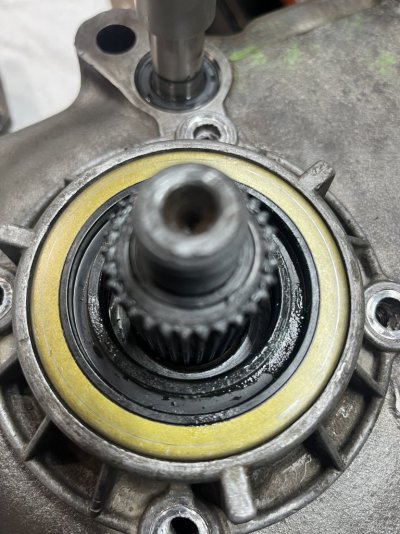
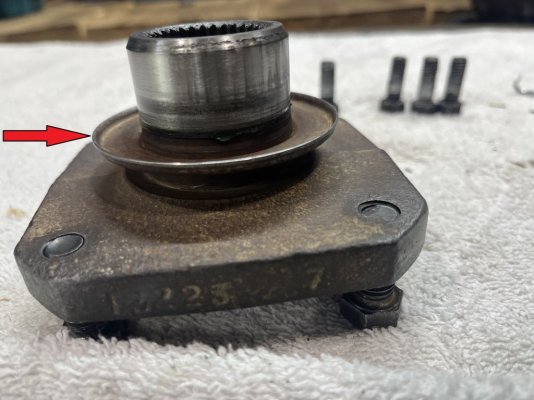
So clearly there's a problem with the seal housing and seal. When I looked closer at the seal (brand new, just installed), I could see there was a gouge, the same diameter as the dust cap on the yoke. That diameter is smaller than the seal itself (and smaller than the hole for the seal in seal housing).
 

Attachments

  • 1_gouge_on_seal.JPG
    1_gouge_on_seal.JPG
    183.4 KB · Views: 8
  • 2_dust_cap_on_yoke.JPG
    2_dust_cap_on_yoke.JPG
    118.4 KB · Views: 7

Mark80K15

Full Access Member
Joined
Apr 18, 2021
Posts
113
Reaction score
78
Location
Sicamous, BC
First Name
Mark
Truck Year
1980
Truck Model
K15
Engine Size
350
So when the yoke is tightened on when the seal housing is present, the yoke dust cap contacts the seal enough that it actually stops the front output shaft from turning. Did not expect that!

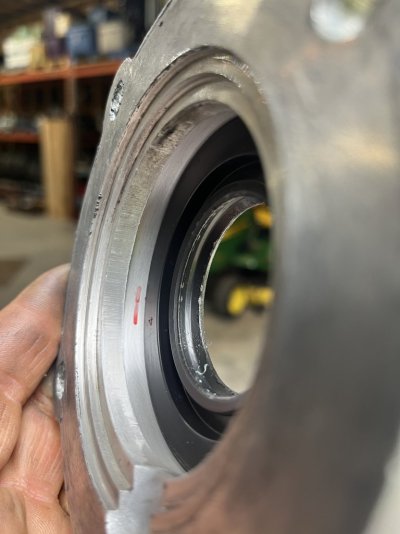
I installed the seal so that its face is flush with the top surface of the seal housing., same as @8:45 of the YouTube GebBuilt NP205 COMPLETE How To Rebuild Part 2. That is also the same as how the seal was installed when I first removed it from the seal housing. However, @ 25:40 of Part 3, GebBuilt shows how the seal is pressed in about 1/4" deeper. This fills a void that is illustrated in this picture of the inside of the seal housing, marked in red.

That void is present when the seal is pressed in flush with the top surface of the seal housing. But then the dust cap contacts the seal. If it's pressed in further as GebBuilt did in Part 3, there will be no contact.

So, is it ok to press in further so the seal is completely seated, and there is no void?
 

Attachments

  • 3_room_for_seal.JPG
    3_room_for_seal.JPG
    97.3 KB · Views: 5

bucket

Super Moderator
Staff member
Moderator
Joined
Aug 3, 2010
Posts
35,149
Reaction score
43,770
Location
Usually not in Ohio
First Name
Andy
Truck Year
'77, '78, '79, '84, '88
Truck Model
K5 thru K30
Engine Size
350-454
As long as it still seals on the yoke, it will be fine.

So maybe I misunderstood before. When it it was tightened and everything locked up, was that just in 4wd, or when shifted into 2hi as well?
 

Craig Nedrow

NADAR UNDER THE RADAR
Supporting Member
Joined
Sep 1, 2018
Posts
1,637
Reaction score
4,059
Location
Washington State
First Name
Craig
Truck Year
1973 (have two), 1985
Truck Model
K10, K20, C20
Engine Size
350, 454, 6.2 Detroit
So what did you replace that is different than stock, besides the twin stick? Sounds like the input stack is to tall, and binds when tightened? Anyway this is a good site to study.
 

Craig Nedrow

NADAR UNDER THE RADAR
Supporting Member
Joined
Sep 1, 2018
Posts
1,637
Reaction score
4,059
Location
Washington State
First Name
Craig
Truck Year
1973 (have two), 1985
Truck Model
K10, K20, C20
Engine Size
350, 454, 6.2 Detroit
This is a good site to help you. I do see the mark on the dust shield, that is not right. Is there a gasket on the cover? Have you tried to use a thicker (or two) gasket on the cover to see if the binding stops? Just trouble shooting.
 

CalSgt

Full Access Member
Joined
Oct 3, 2021
Posts
2,256
Reaction score
5,418
Location
CA
First Name
Casey
Truck Year
1980
Truck Model
Chevy K-10 Custom Deluxe
Engine Size
350
Trying to find the problem, I removed the seal housing from the front output shaft, and put the yoke back on. I wanted to see what would happen if I tightened the yoke on with no seal housing. I tightened the nut to 60 ft-lbs, and everything still turned properly!

So clearly there's a problem with the seal housing and seal. When I looked closer at the seal (brand new, just installed), I could see there was a gouge, the same diameter as the dust cap on the yoke. That diameter is smaller than the seal itself (and smaller than the hole for the seal in seal housing).
So when the yoke is tightened on when the seal housing is present, the yoke dust cap contacts the seal enough that it actually stops the front output shaft from turning. Did not expect that!

I installed the seal so that its face is flush with the top surface of the seal housing., same as @8:45 of the YouTube GebBuilt NP205 COMPLETE How To Rebuild Part 2. That is also the same as how the seal was installed when I first removed it from the seal housing. However, @ 25:40 of Part 3, GebBuilt shows how the seal is pressed in about 1/4" deeper. This fills a void that is illustrated in this picture of the inside of the seal housing, marked in red.

That void is present when the seal is pressed in flush with the top surface of the seal housing. But then the dust cap contacts the seal. If it's pressed in further as GebBuilt did in Part 3, there will be no contact.

So, is it ok to press in further so the seal is completely seated, and there is no void?

Look at the witness marks on the yoke, you can see where the old seal lips used to ride, if the yoke is pushing into the seal farther than it used to that's definite evidence the seal needs to be driven farther into the case.

But

So long as the inner and outer seal lips will still ride on the shiny part of the yoke I'd drive it in farther.
 

Forum statistics

Threads
48,421
Posts
1,067,156
Members
42,812
Latest member
souixchef2
Top